
Honesty Bible Lessons for Kids
Honesty is a foundational biblical character trait that helps children build trust, integrity, and strong relationships with others and with God. Teaching kids what honesty looks like through Scripture gives them a clear understanding of why telling the truth matters, even when it’s difficult. Keep reading to find engaging, Bible-based ideas that help children learn honesty through meaningful discussion, hands-on activities, and real-life application rooted in God’s Word.
How do you define honesty for kids?
Honesty is telling the truth, even when it’s hard. It’s human nature to want to avoid getting into trouble, so it’s often easier to lie instead of getting caught doing something wrong. We would prefer to take the easier road. Telling the truth can sometimes be hard, but honesty is an important godly character.
Honesty can be both the words we say and the actions we take. It’s easy to understand that what we say can either be the truth or a lie. If someone asks us a question, we should give them an honest answer. This means telling the truth.
Our actions must also be honest. For example, cheating on a test is dishonest because it does not reflect what we actually know. If you have a family rule about practicing the piano for 30 minutes every day, and you decide only to practice 20 minutes, this is dishonest, even if no one catches you shortening your practice time.
Honesty Bible Lessons for Kids
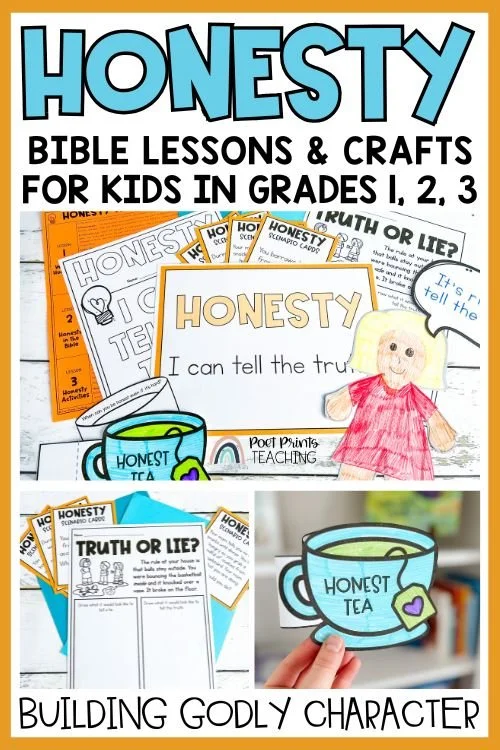
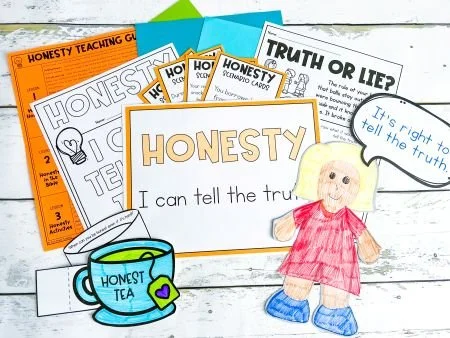
Are you looking for an engaging way to teach children about the character trait of honesty? Use the Bible story of Ananias and Sapphira to help facilitate the learning. Our scripted lessons, printable crafts, and discussion questions are a great resource to help kids learn about this important character trait.
WHAT DOES THE BIBLE SAY ABOUT honesty?
Honesty is important because it honors God and reflects His character. Honesty helps to build trust and integrity. People can rely on an honest person, and they will want to have a relationship with that person. When someone is dishonest, their integrity will be called into question and, likely, people won’t want to interact with them as often.
God calls us to be honest. There are many verses about honesty in the Bible, including the following:
Proverbs 12:22 – “The Lord detests lying lips, but he delights in people who are trustworthy.”
Proverbs 12:19 - “Truthful lips endure forever, but a lying tongue lasts only a moment.”
Colossians 3:9 – “Do not lie to each other, since you have taken off your old self with its practices.”
Ephesians 4:29 - “Do not let any unwholesome talk come out of your mouths, but only what is helpful for building others up according to their needs, that it may benefit those who listen.
For children, it is sometimes easier to recognize the value of honesty when they hear about what happens in a story where someone is dishonest. There are several stories in the Bible about people who chose to be dishonest. Adam and Eve lied to God in Genesis 3. There are two stories where Abraham lies about Sarah being his sister instead of his wife in Genesis 12:10-20 and again in Genesis 20:1-18. Another story of dishonesty was when Rebekah and Jacob tried to deceive Isaac in Genesis 27:1-29.
HOW DO YOU TEACH KIDS ABOUT honesty?
Take time to teach children the definition of honesty and explore different examples of what honesty looks like. These examples can include stories from the Bible where people chose honesty (or didn’t choose honesty), as well as modern, real-life situations kids may face.
Discuss these stories and scenarios, then apply the material by having children role-play situations in which they must demonstrate honesty. Use hands-on crafts and activities to help them engage with the topic. Then, before they head home, challenge them to practice honesty throughout the week.
HONEST SELF PORTRAITS project
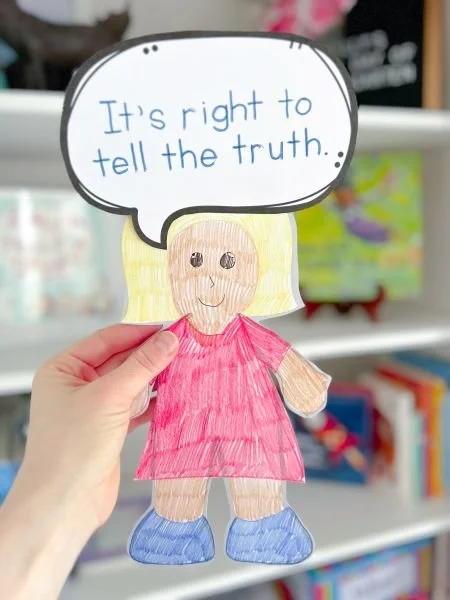
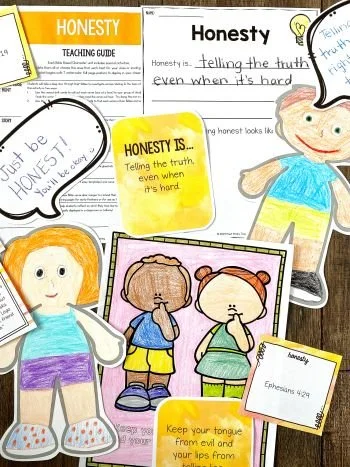
In this simple art project, kids will create a self-portrait and a simple saying encouraging others to be honest. Give each child a basic body-shape outline, which can be found in both Honesty for Little Learners and Honesty for Older Kids, or allow children to draw their own.
Then have kids draw and color their self-portrait on top of the simple outline, adding clothing, facial features, hair, etc. If you have time, try adding a background!
When you are done, ask the kids to think of a simple phrase that they could say to a peer that might encourage them to be honest. An encouraging Bible verse could also work! Write this phrase in the speech bubbles provided and attach the speech bubble to the self-portrait using tape or a stapler. Display your self-portraits proudly!
Bible Sword Drill
Using a Sword Drill to introduce children to the Bible is an effective way to help them navigate the pages of Scripture and understand the relationships among the books of the Bible. A Sword Drill is a simple exercise in which children are given a verse to look up and then must search for it.
To help kids with this, show them where the Table of Contents is in the Bible. Then teach them how to locate the book in the Table of Contents, flip to the page, and search for the chapter and verse. At first, this will be a time-consuming and awkward task for kids to manage. There will be some hand-holding and guidance. But this is an important skill for kids to have, so fostering this skill is worth the time.
You’ll find printable cards with the verses and lined pages for children to write the verses in the Honesty Bible Lesson for Older Kids.
BIBLE STORY about Honesty - Ananias and Sapphira
Bible stories are an effective means of teaching godly character traits. Take time to read a story about honesty, discuss it, and complete an activity that connects to the story.
The story of Annanias and Sapphira found in Acts 5:1-11 centres around the theme of honesty.
After reading the story, discuss the concept of honesty. Annanias and Sapphira chose to be dishonest to appear more important. They lied about the money they gave to the church so they could appear more generous than they really were. This resulted in some extreme consequences. While we likely won’t experience consequences like they did (death), dishonesty can be a dangerous thing.
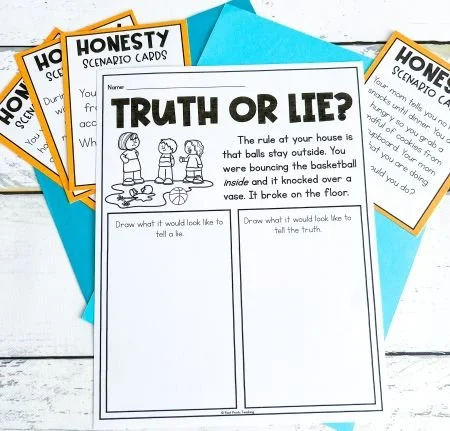
Next, do an activity to reinforce the learning. The Honesty Bible Lesson for Older Kids includes a printable reflection page where children can reflect on situations in which it might be hard to show honesty.
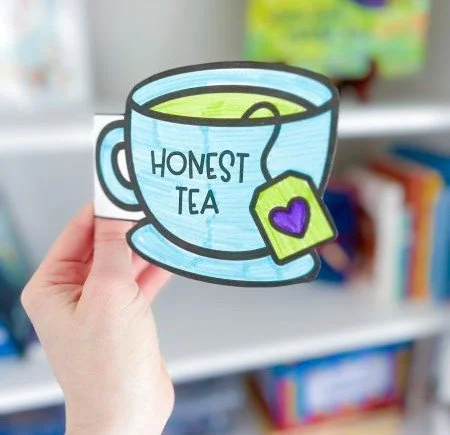
The Honesty Bible Lesson for Little Learners includes a playful printable craft called “Honest Tea.” Children color and cut out two teacups: one labelled “Honest Tea,” and another with space to draw a situation where they can choose honesty. This simple craft encourages family conversations at home and helps kids remember that honesty is the best choice.
MORE Crafts and activities to teach about honesty
Two Truths and a Lie: This is often used as a get-to-know-you game; however, this can be turned into a great learning opportunity. Instead of having your children come up with two truths and a lie, have them try to figure out the two truths and the lie about you. This will help keep the activity from getting too chaotic, as young children might make up some radical things. Come up with simple things to “lie” about, like what you ate for breakfast or what kind of car you drive. Then explain to kids that lies might sound realistic and believable at times, so when you find an honest friend, you can feel safe knowing that they are telling the truth.
Lying Object Lessons: Over the Moon has a great object lesson about lying, involving salt and ice cream. In this object lesson, you sprinkle ice cream with salt and tell kids that you can cover the salty taste with other toppings. This is a valuable lesson: a lie doesn’t conceal the truth.
Truth Traffic Light: A traffic light tells us to stop, slow down, and go. This can be a great analogy for truth-telling. When we are faced with lying versus telling the truth, we should think before we speak (yellow light), stop ourselves from telling a lie (red light), and tell the truth (green light). Create a simple traffic-light craft to serve as a visual aid. Check out Housing a Forest for a simple traffic-light craft using a popsicle stick and construction paper. And Crafting a Fun Life features a traffic-light craft using DIY puffy paint.
WOULD YOU LIKE MORE LESSONS ABOUT building godly character?
This lesson on contentment is part of a seven-part Character Education mini-series. Other lessons include contentment, kindness, courage, forgiveness, perseverance, and self-control.