Perseverance Bible Lessons for Kids - Building Resilience

Perseverance is an important godly character trait for kids to learn as they grow in faith and life skills. Through Bible-based teaching, hands-on crafts, printable lessons, and engaging activities, children can discover how God calls them to keep going, trust Him during challenges, and remain faithful even when things feel difficult.

How do you define perseverance to kids?

Perseverance is not giving up on something, even if it’s really hard. We live in a world that wants things fast, and we don’t like to wait. When we are learning something new, and it takes a long time, we can become frustrated and give up.

But God wants us to persevere and keep going, even when things get hard. Sometimes it will take a long time to learn something new. Sometimes, a situation we are going through will feel really hard, and we will want to give up. But perseverance is the ability to keep going and not give up.

For example, when math homework feels difficult, seek help instead of giving up. This is showing perseverance. When you’re learning how to ride a bike, keep practicing because the more you practice, the better you will get.

Perseverance Bible Lessons for Kids

Are you looking for an engaging way to teach children about the character trait of Perseverance? Use the Bible story of Noah to facilitate learning. Our scripted lessons, printable crafts, and discussion questions are a great resource to help kids learn about this important character trait.

(Click HERE to shop the 2nd, 3rd, and 4th grade version!)

Perseverance builds resilience

Resilience means being able to bounce back when challenges arise. The more we practice perseverance, the more resilience we build. Perseverance is a choice in our actions. This means we choose to keep going even when something is difficult. Resilience is a choice in how we respond to our feelings, meaning we choose to calm down, think differently, and see challenges as opportunities for growth.

HOW DO YOU TEACH KIDS ABOUT Perseverance?

Take time to teach children the definition of perseverance and explore different examples of what perseverance looks like. These examples can include stories from the Bible where people chose perseverance (or didn’t choose perseverance), as well as modern, real-life situations kids may face. 

Discuss these stories and scenarios, then apply the material by having children role-play situations that require perseverance. Use hands-on crafts and activities to help them engage with the topic. Before they head home, challenge them to practice perseverance throughout the week.

The ‘Perseverance’ lessons for littler kids in kindergarten and first grade includes a number of hands-on activities and scripted lessons.

BUILDING BLOCKS OF PERSEVERANCE craft

Sometimes it is very hard to have a mindset of perseverance. It’s easy to become frustrated and give up, rather than using strategies to calm our bodies and persevere.

Brainstorm various strategies for what to do when you don’t want to show perseverance. Some ideas might include praying, asking for help, finding someone who is already good at that task, taking a break, and coming back later. 

Then give each child a ‘cube’ template found in Perseverance for Older Kids or Perseverance Lesson for Little Learners. The template for older children is largely blank, allowing them to draw and write their own ideas, whereas the cube for younger learners already includes traceable words, so they only need to trace them. 

Once kids have finished writing and coloring their cube, help them assemble and practice rolling it. This craft is a great visual reminder and a practical tool that kids can use when they are stuck in frustration. 

A plan for Perseverance – spinner craftivity

Having a plan can help children (and adults) visualize a step-by-step approach to persevering through a challenging task. Take time to help children create a perseverance plan to help them learn something that has been causing frustration. This could be riding a bike, doing math homework, learning a new piano song, etc.

Use the spinner template pages in Perseverance Bible Lessons for Older Kids to help students develop their perseverance plan. Take time to brainstorm ideas, then have children write and draw how they will work (and persevere) until they have accomplished this new skill. 

Bible Sword Drill

Using a Sword Drill to introduce children to the Bible is an effective way to help them navigate the pages of Scripture and understand the relationships among the books of the Bible. A Sword Drill is a simple exercise in which children are given a verse to look up and then must search for it.

To help kids with this, show them where the Table of Contents is in the Bible. Then teach them how to locate the book in the Table of Contents, flip to the page, and search for the chapter and verse. Initially, this will be a time-consuming and awkward task for children to manage. There will be some hand-holding and guidance. However, this is an important skill for children to have, so fostering this it is worthwhile.

You’ll find printable cards with the verses and lined pages for children to write the verses in the Perseverance Bible Lesson for Older Kids.

BIBLE STORY about Perseverance - Noah

Bible stories are an effective means of teaching biblical character traits. Take time to read a story about perseverance, discuss it, and complete an activity that connects to the story. 

The story of Noah found in Genesis 6-9 pairs well with the topic of perseverance. 

After reading the story, discuss the concept of perseverance. Noah was faced with a challenging task: to build a gigantic boat. Despite the odds, Noah persevered for many, many years and completed the task. Noah and his family were rewarded for their perseverance because they were the only humans safe aboard the ark when the flood came.

Next, do an activity to reinforce the learning. The Perseverance Bible Lesson for Older Kids includes a reflection page where kids brainstorm the things Noah might have been feeling while he built the ark. Then they can brainstorm things they can persevere at.

The Perseverance Bible Lesson for Little Learners includes a printable ark scene craft where kids will color and cut out the ark as well as the animals. Then they can glue Noah and the animals onto the ark.

MORE Crafts and activities to teach about Perseverance

  • Perseverance Obstacle Course: Set up an obstacle course using various supplies from around your room and have kids complete the course. Challenge them to use perseverance and not give up.

  • Perseverance Physical Challenge: Do a series of exercises like squats, push-ups, wall sits, and burpees. This will make kids tired, but turn it into a fun perseverance challenge and encourage kids to keep going, even when it’s hard.

  •  Snail Crafts: Check out Kids Craftroom for some cute snail crafts. Snails pair well with perseverance because, even though snails are slow creatures, they still get to where they want to go. Perseverance doesn’t mean learning something quickly. It might be slow going, but perseverance means never giving up. 

WOULD YOU LIKE MORE LESSONS ABOUT Godly CHARACTER BUILDLING?

This lesson on contentment is part of a seven-part Character Education mini-series. Other lessons include contentment, kindness, courage, forgiveness, self-control, and honesty. 

The Parable of the Talents - Bible Lessons for Kids

Teaching the Parable of the Talents to kids is a meaningful way to help kids understand responsibility, faithfulness, and the wise use of God-given gifts. Bible-based ideas make this powerful story easy for children to grasp through printable lesson plans, engaging crafts, and hands-on activities that show how God calls each person to use what they have been given to honor Him and serve others.

WHAT IS A PARABLE?

A parable was a short story that Jesus used to teach people about God. These stories helped people understand what Jesus was saying because He connected them to people’s everyday lives. Parables can also be easier to remember than long speeches.

THE PARABLE OF THE TALENTS

The Parable of the Talents can be found in Matthew 25:14–30. It is also known as the Parable of the Three Servants.

In this parable, Jesus tells of a master who goes on a journey. Before leaving, he gives one servant five bags of money, another servant two bags of money, and a third servant one bag of money, each according to his ability. The first two servants put the money to work and earned five more bags and two more bags. The third servant dug a hole and hid his master’s money in the ground.

When the master returned, he settled accounts with the servants. The first two showed how the money had grown, and the master was pleased with them. The third servant explained that he hid the money, and the master was upset. The master took the bag of money from the third servant and gave it to the servant who had ten bags, and the unfaithful servant was punished.

Parable of the Talents - Bible Lessons for Kids

Are you looking for a simple way to teach kids about the Parable of the Talents? Be sure to check out our scripted lessons, discussion questions, and printable crafts. These resources are perfect for kids aged 3-8.

(Click HERE for the preschool/kindergarten version)

BACKGROUND INFORMATION ABOUT THE PARABLE OF THE TALENTS

In this parable, the word 'talent' refers to a specific amount of money. Scholars believe that a talent was about 50 pounds, but it could have weighed more! Talents are also special abilities that God has given us. God wants us to use the good gifts He has given us to help His Kingdom grow. 

We need to be like the first two servants in this parable, and not like the last servant who hid the money. God wants us to use our time, money, abilities, and intelligence to help people learn about Him. 

a treasure chest of talents

As we grow and get older, we will continue to discover our talents and gifts. It’s like God has put treasure inside us for us to discover! Some talents show up right away, and others will be discovered later. Our talents are treasures we can use to help God’s Kingdom. Kids will love this analogy!
Printable Treasure Chest for Preschool and Kindergarten

Make a printable treasure chest craft to help kids connect with this idea. Using the template pieces from The Parable of the Talents for Preschool, kids can assemble their paper treasure chest and decorate it with stickers, crayons, and the provided printable jewels. When they take their treasure chest home, it could spark great conversations in which kids share their talents with their families.

Print and Fold Treasure Chest for Bigger Kids

Older Kids will create a fold-out treasure chest to write or draw at least three talents God has given them. The template pieces can be found in The Parable of the Talents for Older Kids. After writing/drawing these ideas, kids can decorate their treasure chests with stickers, crayons, and the provided printable jewels. 

After doing the craft, remind kids that God wants us to use our gifts wisely. Our talents are valuable and can be used to serve God and bless others. 


OTHER CRAFTS AND ACTIVITIES TO TEACH ABOUT THE PARABLE OF THE TALENTS

  • Talent Coins: Brainstorm with kids about different talents that God has given them. This could be “I am kind”, “I am good at listening”, “I am good at soccer”, etc. Then have kids write these on small circular pieces of paper (to look like coins from the parable). Put these in an envelope that kids can decorate.

  • Talent Gift Box: Purchase wooden or paper boxes from the Dollar Store. Have children decorate these boxes with paint, markers, stickers, glitter, etc. Next, have kids write some of their different talents on slips of paper. They can place these talents in the box as a reminder that they are a gift from God and should be used wisely.

  • Grow Your Talents: Challenge kids to pick one talent they want to put into practice this week, something they want to get better at and use to glorify God. Help kids come up with a “game plan” to put their talent into action and practice.

YOUTUBE VIDEOS ABOUT THE PARABLE OF THE TALENTS

Take some time to watch a YouTube version of the Parable of the Three Servants. This will likely help kids visualize the story better. But before showing any videos, be sure to preview them. Here are a few suggestions:


WANT TO CONTINUE LEARNING ABOUT THE PARABLES OF JESUS?

This lesson is part of a five-week series on the Parables of Jesus. The other lessons include The Parable of the Mustard Seed, The Parable of the Good Samaritan, The Parable of the Unforgiving Servant, and The Parable of the Great Banquet. 

And for more parable lessons, from an earlier parable series, check out Parable of Jesus for Older Kids and Parables of Jesus for Preschool.

Honesty Bible Lessons for Kids

Honesty is a foundational biblical character trait that helps children build trust, integrity, and strong relationships with others and with God. Teaching kids what honesty looks like through Scripture gives them a clear understanding of why telling the truth matters, even when it’s difficult. Keep reading to find engaging, Bible-based ideas that help children learn honesty through meaningful discussion, hands-on activities, and real-life application rooted in God’s Word.

How do you define honesty for kids?

Honesty is telling the truth, even when it’s hard. It’s human nature to want to avoid getting into trouble, so it’s often easier to lie instead of getting caught doing something wrong. We would prefer to take the easier road. Telling the truth can sometimes be hard, but honesty is an important godly character.

Honesty can be both the words we say and the actions we take. It’s easy to understand that what we say can either be the truth or a lie. If someone asks us a question, we should give them an honest answer. This means telling the truth.

Our actions must also be honest. For example, cheating on a test is dishonest because it does not reflect what we actually know. If you have a family rule about practicing the piano for 30 minutes every day, and you decide only to practice 20 minutes, this is dishonest, even if no one catches you shortening your practice time.

Honesty Bible Lessons for Kids

Are you looking for an engaging way to teach children about the character trait of honesty? Use the Bible story of Ananias and Sapphira to help facilitate the learning. Our scripted lessons, printable crafts, and discussion questions are a great resource to help kids learn about this important character trait.

(Click HERE for the 2nd, 3rd, and 4th grade version)

WHAT DOES THE BIBLE SAY ABOUT honesty?

Honesty is important because it honors God and reflects His character. Honesty helps to build trust and integrity. People can rely on an honest person, and they will want to have a relationship with that person. When someone is dishonest, their integrity will be called into question and, likely, people won’t want to interact with them as often. 

God calls us to be honest. There are many verses about honesty in the Bible, including the following:

  • Proverbs 12:22 – “The Lord detests lying lips, but he delights in people who are trustworthy.”

  • Proverbs 12:19 - “Truthful lips endure forever, but a lying tongue lasts only a moment.”

  • Colossians 3:9 – “Do not lie to each other, since you have taken off your old self with its practices.”

  • Ephesians 4:29 - “Do not let any unwholesome talk come out of your mouths, but only what is helpful for building others up according to their needs, that it may benefit those who listen.

For children, it is sometimes easier to recognize the value of honesty when they hear about what happens in a story where someone is dishonest. There are several stories in the Bible about people who chose to be dishonest. Adam and Eve lied to God in Genesis 3. There are two stories where Abraham lies about Sarah being his sister instead of his wife in Genesis 12:10-20 and again in Genesis 20:1-18. Another story of dishonesty was when Rebekah and Jacob tried to deceive Isaac in Genesis 27:1-29. 

HOW DO YOU TEACH KIDS ABOUT honesty?

Take time to teach children the definition of honesty and explore different examples of what honesty looks like. These examples can include stories from the Bible where people chose honesty (or didn’t choose honesty), as well as modern, real-life situations kids may face. 

Discuss these stories and scenarios, then apply the material by having children role-play situations in which they must demonstrate honesty. Use hands-on crafts and activities to help them engage with the topic. Then, before they head home, challenge them to practice honesty throughout the week.

HONEST SELF PORTRAITS project

In this simple art project, kids will create a self-portrait and a simple saying encouraging others to be honest. Give each child a basic body-shape outline, which can be found in both Honesty for Little Learners and Honesty for Older Kids, or allow children to draw their own.

Then have kids draw and color their self-portrait on top of the simple outline, adding clothing, facial features, hair, etc. If you have time, try adding a background!

When you are done, ask the kids to think of a simple phrase that they could say to a peer that might encourage them to be honest. An encouraging Bible verse could also work! Write this phrase in the speech bubbles provided and attach the speech bubble to the self-portrait using tape or a stapler. Display your self-portraits proudly!

Bible Sword Drill

Using a Sword Drill to introduce children to the Bible is an effective way to help them navigate the pages of Scripture and understand the relationships among the books of the Bible. A Sword Drill is a simple exercise in which children are given a verse to look up and then must search for it.

To help kids with this, show them where the Table of Contents is in the Bible. Then teach them how to locate the book in the Table of Contents, flip to the page, and search for the chapter and verse. At first, this will be a time-consuming and awkward task for kids to manage. There will be some hand-holding and guidance. But this is an important skill for kids to have, so fostering this skill is worth the time.

You’ll find printable cards  with the verses and lined pages for children to write the verses in the Honesty Bible Lesson for Older Kids.

BIBLE STORY about Honesty - Ananias and Sapphira

Bible stories are an effective means of teaching godly character traits. Take time to read a story about honesty, discuss it, and complete an activity that connects to the story. 

The story of Annanias and Sapphira found in Acts 5:1-11 centres around the theme of honesty. 

After reading the story, discuss the concept of honesty. Annanias and Sapphira chose to be dishonest to appear more important. They lied about the money they gave to the church so they could appear more generous than they really were. This resulted in some extreme consequences. While we likely won’t experience consequences like they did (death), dishonesty can be a dangerous thing. 

Next, do an activity to reinforce the learning. The Honesty Bible Lesson for Older Kids includes a printable reflection page where children can reflect on situations in which it might be hard to show honesty. 

The Honesty Bible Lesson for Little Learners includes a playful printable craft called “Honest Tea.” Children color and cut out two teacups: one labelled “Honest Tea,” and another with space to draw a situation where they can choose honesty. This simple craft encourages family conversations at home and helps kids remember that honesty is the best choice.

MORE Crafts and activities to teach about honesty

  • Two Truths and a Lie: This is often used as a get-to-know-you game; however, this can be turned into a great learning opportunity. Instead of having your children come up with two truths and a lie, have them try to figure out the two truths and the lie about you. This will help keep the activity from getting too chaotic, as young children might make up some radical things. Come up with simple things to “lie” about, like what you ate for breakfast or what kind of car you drive. Then explain to kids that lies might sound realistic and believable at times, so when you find an honest friend, you can feel safe knowing that they are telling the truth.

  • Lying Object Lessons: Over the Moon has a great object lesson about lying, involving salt and ice cream. In this object lesson, you sprinkle ice cream with salt and tell kids that you can cover the salty taste with other toppings. This is a valuable lesson: a lie doesn’t conceal the truth.

  • Truth Traffic Light: A traffic light tells us to stop, slow down, and go. This can be a great analogy for truth-telling. When we are faced with lying versus telling the truth, we should think before we speak (yellow light), stop ourselves from telling a lie (red light), and tell the truth (green light). Create a simple traffic-light craft to serve as a visual aid. Check out Housing a Forest for a simple traffic-light craft using a popsicle stick and construction paper. And Crafting a Fun Life features a traffic-light craft using DIY puffy paint.

WOULD YOU LIKE MORE LESSONS ABOUT building godly character?

This lesson on contentment is part of a seven-part Character Education mini-series. Other lessons include contentment, kindness, courage, forgiveness, perseverance, and self-control. 

The Parable of the Mustard Seed - Bible Lessons for Kids

Teaching the Parable of the Mustard Seed to kids is a wonderful way to help them understand how God can use even the smallest faith to do big things. Simple, Bible-based ideas bring this short but powerful story to life through engaging lesson plans, hands-on craft ideas, and interactive activities that help children see how their faith can grow and make a difference in everyday life.

WHAT IS A PARABLE?

A parable was a short story that Jesus used to teach people about God. These stories helped people understand what Jesus was saying because He connected them to people’s everyday lives. Parables can also be easier to remember than long speeches.


THE PARABLE OF THE MUSTARD SEED

The Parable of the Mustard Seed can be found in Matthew 13:31–32, Mark 4:30–32, and Luke 13:18–19. In this parable, Jesus says the Kingdom of God is like a mustard seed that a man took and planted in his garden. Then it grew into a tree, and birds made homes in its branches.

Parable of the Mustard Seed Bible Lessons for Kids

Are you looking for an easy and effective way to teach about the Parable of the Mustard Seed? Be sure to check out our scripted lesson, printable crafts, and discussion questions. Perfect for kids aged 3-8.

(Click HERE for the 1st, 2nd, 3rd grade version)

BACKGROUND INFORMATION ABOUT THE PARABLE OF THE MUSTARD SEED

In this parable, Jesus compares the Kingdom of God to a mustard seed. A mustard seed is very small. It's about the size of a grain of sand. Even though the seed is so small, it grows into a tall tree. Mustard trees usually grow between 6 and 12 feet tall. Sometimes, even as tall as 15-20 feet.

The Kingdom of God is anywhere God is King, so this isn’t a specific place.

God's Kingdom grows when more people join God's family. Small seeds of faith can grow into something big in God's Kingdom. These small acts might be telling someone about Jesus, serving others, forgiving someone, or showing kindness to someone. 

SEEDS OF FAITH - PRINTABLE CRAFT FOR PRESCHOOL

Kids in preschool and kindergarten will decorate this printable jar and glue on real seeds to remind them of the parable.

A simple printable craft can serve as a great connecting activity when teaching Bible stories. Crafts can also serve as conversation starters at home, helping parents understand what their children are learning in class.

For this craft, kids will glue seeds onto a paper template of a jar. To start, kids will cut out and decorate their jar. Then give each child a few seeds to glue into their jar. They will also glue a printable verse onto the jar to remind them of the story. For template pieces, check out The Parable of the Mustard Seed for Preschool.

MUSTARD TREE CRAFT FOR OLDER KIDS

Older kids will create a visual recreation of the parable.

Older kids will enjoy painting a mustard tree using the template from The Parable of the Mustard Seed for Older Kids. Use a sponge or a pompom to have kids dab paint onto their tree. Once the paint is dry, add the paper nest and bird pieces to the tree. Kids can even glue a small seed to the base of the tree to remind them that seeds are very small, but grow into something big.

Be sure to help kids see that even small acts of faith can have a big impact on the Kingdom of God.


OTHER CRAFTS AND ACTIVITIES TO TEACH ABOUT THE PARABLE OF THE MUSTARD SEED

  • Salt Dough Seed Art: Make salt dough ornaments by pressing seeds of various sizes into the dough to create a pattern or picture. Use popcorn, pumpkin seeds, sunflower seeds, chia seeds, etc. Then let kids get creative with their patterns and art. Make sure to put a hole in the salt dough before it dries so kids can string it and hang it as an ornament somewhere in their house. For a simple salt dough recipe, check out Yummy Toddler Food.

  • Seed Mosaic: Check out First Palette for beautiful seed mosaic instructions. Kids will love creating pictures using paper, glue and seeds.

  • Mustard Seed Visual: Compare various seeds so kids can see just how small a mustard seed is compared to others. Take this one step further and have kids glue various-sized seeds onto a piece of paper, then write the verse: “Faith as small as a mustard seed can move mountains.” 

  • Make Necklaces or bracelets: Find small beads and have kids string them into a necklace or bracelet. The small beads will serve as a visual reminder that even small steps of faith make a big difference. 

YOUTUBE VIDEOS ABOUT THE PARABLE OF THE MUSTARD SEED

Even though this is a short parable, there is still value in watching a video about it. Be sure to preview any video you intend to show your kids. Here are a couple suggestions:

WANT TO CONTINUE LEARNING ABOUT THE PARABLES OF JESUS?

This lesson is part of a five-week series on the Parables of Jesus. The other lessons include The Parable of the Talents, The Parable of the Good Samaritan, The Parable of the Unforgiving Servant, and The Parable of the Great Banquet. 

And for more parable lessons, from an earlier parable series, check out Parable of Jesus for Older Kids and Parables of Jesus for Preschool.

Contentment and Gratitude Bible Lessons for Kids

Teaching kids about contentment is an important component of Bible-based character education, helping them learn to be thankful and to trust God in every situation. There are many engaging, faith-filled ideas to teach contentment (and gratitude) to children through simple crafts, hands-on activities, and meaningful Bible lessons. Designed for parents, teachers, and children’s ministry leaders, these creative contentment activities make it easy to connect biblical truths with everyday life and help kids understand what it means to be satisfied with what God has given them.
How do you define contentment to kids?

Simply put, contentment is being thankful and satisfied with what you have and not wanting more. For example, contentment is playing with the toys you already have rather than wanting the newest toy your friend has. God has given us many good things, and God cares for our needs. Being content shows our gratitude to Him.
Contentment Bible Lessons for Kids

Are you searching for an engaging way to teach kids about the character trait of contentment? Use the Bible story of God Providing Manna in the Desert as a springboard for learning. Our scripted lessons, printable crafts, and discussion questions are a great resource to help kids learn about this important character trait.

(Click HERE for the kindergarten/1st grade version.)

WHAT DOES THE BIBLE SAY ABOUT CONTENTMENT?

The Bible teaches that contentment and trust in God go hand in hand. We can be thankful and have peace because we know that God promises to always be with us and will provide for our needs. Here are some Bible verses that teach about contentment:

  • Psalm 23:1 - “The Lord is my shepherd, I lack nothing.”

    • God provides for our needs. 

  • Matthew 6:28-33 - In this passage of Scripture, Jesus teaches that we need not worry about clothing, food, or the future because God cares for us. This passage is about not worrying, but it can also be connected to contentment.

  • Hebrews 13:5 - “Keep your lives free from the love of money and be content with what you have, because God has said, 'Never will I leave you; never will I forsake you.”

    • Loving God is more important than having stuff.

  • Philippians 4:11-13 - “I am not saying this because I am in need, for I have learned to be content whatever the circumstances. I know what it is to be in need, and I know what it is to have plenty. I have learned the secret of being content in any and every situation, whether well fed or hungry, whether living in plenty or in want. I can do all things through him who gives me strength.”

    • These verses teach us that Jesus helps us to be content. Contentment is something we can practice and cultivate.

HOW DO YOU TEACH KIDS ABOUT CONTENTMENT?

Take time to teach children the definition of contentment and examine different examples of contentment. This could be stories from the Bible in which people were content or not, or it could be modern real-life scenarios. Take time to discuss these stories and scenarios. Then, get really practical and have kids act out scenarios where they need to show contentment. Do crafts and activities to help them engage with the topic. Then, before they head home, challenge them to practice contentment throughout the week! 


NEEDS VS. WANTS: CUT AND PASTE FOR PRESCHOOL

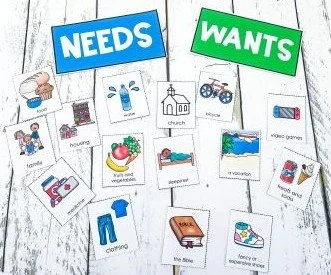
A helpful way to start teaching about contentment is to examine the differences between needs and wants. Needs are necessities for survival, such as water, food, shelter, and love. Wants are things you want to have, but can live without, such as video games, dessert, or the newest Lego set. 

To help young learners distinguish between needs and wants, have them complete a simple cut-and-paste activity in which they glue pictures of their needs and wants onto a T-chart. You could use photos from a magazine, or you could use the printable version found in Contentment for Little Learners


GRATITUDE JOURNAL

Gratitude journals are a great way to help kids think about all the blessings they have in their lives. This is often a practice around Thanksgiving, but reflecting on what we are thankful for is something we should practice throughout the year.

Take time to brainstorm ideas with your kids and then have them put their ideas into their gratitude journals. In Contentment Bible Lesson for Older Kids, you’ll find several journal options: lines, interlined, traceable words, and blank pages for pictures. This way, you can adapt the journal to meet your students’ needs.

In Contentment Bible Lesson for Little Learners, you’ll also find two versions: one with a sentence starter and then a blank space to finish the sentence, and one with traceable words so kids can trace and then draw a picture.


CONTENTMENT BIBLE STORY - Manna in the Desert

Bible stories are an effective means of reinforcing biblical character traits. Taking time to read a story about contentment, discussing it, and completing an activity that connects with the story is a great way to solidify learning. 

Exodus 16 recounts God's provision of manna in the Desert. Prior to this event, God had rescued the Israelites from slavery in Egypt, and yet, the Israelites were grumbling and complaining in the desert. God sent manna and quail to satisfy the people’s hunger, and even still, the Israelites continued to grumble and complain.

This story is a great springboard for conversations about contentment. Children can examine how the Israelites responded to God’s provision and then discuss what contentment could have looked like in this story.

After reading the story and discussing it, do an activity to reinforce the learning. Be sure to check out Contentment Bible Lesson for Older Kids for an activity in which kids draw a simple comic retelling the main parts of the story.

Check out Contentment Bible Lesson for Little Learners for an age-appropriate printable craft in which children create a scene of manna being provided each morning for the Israelites.


MORE CONTENTMENT BIBLE LESSON IDEAS

  • Gratitude Jar: Give kids strips of paper and a mason jar. As they think of things they are thankful for, they can write their idea on a strip of paper and then place the strip in the jar. This is a visual reminder that our lives are full of blessings, just like the mason jar is full of strips of paper. 

  • Balloon Bouncing: Get balloons in two different colors. Blow up several balloons in each of the two colors. Tell kids that one of the colors represents being thankful, and the other color represents complaining. Have children play a game in which they must keep the “thankful” balloons in the air and let the “complaint” balloons fall to the floor.

  • A Backpack Illustration: Do a simple object lesson with kids where you fill a backpack with things you’ll need for a camping trip. Then ask kids if they need more things, or if the backpack has enough stuff in it. This is a great visual to show kids that we don’t need more than can fit.

  • Contentment Bracelets: The Meaingful Mama has a cute Contentment Game. She encourages us to make bracelets with our kids which say, “Be Content”. Then challenge your kids to go a whole day without complaining. As soon as they complain, the bracelet is confiscated for a period, after which they may try again.


WOULD YOU LIKE MORE LESSONS ABOUT building godly character?

This lesson on contentment is part of a seven-part Character Education mini-series. Other lessons include courage, forgiveness, honesty, kindness, perseverance, and self-control.

The Parable of the Great Banquet - Bible Lessons for Kids

Teaching kids the Parable of the Great Banquet is a meaningful way to help them understand God’s invitation, grace, and the joy of being welcomed into His kingdom. There are many creative, kid-friendly ideas to bring this powerful Bible story to life through printable lesson plans, hands-on crafts, and activities that help children grasp the message that God invites everyone to accept His invitation.

WHAT IS A PARABLE?

A parable was a short story that Jesus used to teach people about God. These stories helped people understand what Jesus was saying because He connected them to people’s everyday lives. Parables can also be easier to remember than long speeches.

THE PARABLE OF THE GREAT BANQUET

The Parable of the Great Banquet can be found in Luke 14:15-24. Jesus teaches that a man prepared a great banquet and invited many guests. When the time for the banquet came, the invited guests made excuses and did not come. The excuses sounded important, like getting married, buying new land, and buying new oxen.

But the master became upset when he heard this and sent his servant to invite the poor, crippled, blind, and lame instead. When he discovered there was still room at the banquet, he invited even more people. And those who were originally invited did not get to come to the banquet.

The Parable of the Great Banquet for Kids

Are you looking for an easy and effective way to teach about the Parable of the Great Banquet? Be sure to check out our scripted lessons, printable crafts and discussion questions.

(Click HERE for the preschool/kindergarten version!)

BACKGROUND INFORMATION ABOUT THE GREAT BANQUET

In this parable, the master of the house represents God, and the feast represents God's kingdom. The people originally invited to the feast represent anyone who thought they were automatically part of God's Kingdom, not realizing they needed to accept the invitation first. This included many of the Pharisees and religious leaders.

Daily activities and excuses can distract us from accepting God's invitation. God's invitation to be part of His Kingdom is for everyone, and it’s important that we don’t miss it because we’re too busy and distracted.

INVITATIONS TO GOD’S KINGDOM CRAFT FOR PRESCHOOLERS

Little kids will make postcard invitations as a reminder that they’re invited to God’s kingdom!

Receiving an invitation is really exciting, especially for preschoolers. Getting invited to a party is a huge deal!

Kids in preschool and kindergarten will be very familiar with the concept of an invitation, so take time to decorate invitations with crayons, stickers, glitter, and other materials.

These invitations are inviting people to join God’s Kingdom! Kids can keep the invitations as a reminder of the lesson, or give them out to a friend or neighbor.

For a printable template, check out The Parable of the Great Banquet for Preschoolers. 

SETTING THE TABLE PRINTABLE CRAFT FOR OLDER KIDS

Older kids will make this fun place setting craft.

A banquet is an incredible feast and requires preparation. One of the things that needs to be done before the banquet is setting the table. In this printable craft from The Parable of the Great Banquet for Older Kids, kids will use the template pieces to create a table setting. 

After kids create their craft, be sure to connect back to the story. Jesus taught that God invites everyone to be part of His Kingdom. Just as places are set at the table for guests, God is preparing a place for those who accept his invitation. 


OTHER CRAFTS AND ACTIVITIES TO TEACH ABOUT THE GREAT BANQUET

  • Banquet Snack: Tell the story while sitting around a “banquet” snack. Set up a long table and, if possible, set it to look like a party. Then share a snack and tell the story. 

  • Banquet Table Scene: Use a roll of paper and cut a piece to be the length of a table. Tape the paper to a long table, then have kids work together to draw various foods that might be at the banquet. 

  • Banquet Relay: Create relay races that connect to preparing or attending the banquet. Kids can race to carry items like paper plates, napkins, or pretend food to a table, or run one at a time to the table as “guests” arriving at the banquet.

  • Excuses, Excuses: Have kids brainstorm excuses that someone might make when they don’t want to go to a party. Then have a conversation about how God has invited us into His Kingdom, and we don’t want to make excuses.


YOUTUBE VIDEOS ABOUT THE PARABLE OF THE GREAT BANQUET

Using videos is a great way to bring Bible stories to life for kids, especially those who learn best by seeing. Always take a moment to watch the videos beforehand to ensure they are suitable for your group. Below are a couple of helpful options to consider:


WANT TO CONTINUE LEARNING ABOUT THE PARABLES OF JESUS?

This lesson is part of a five-week series on the Parables of Jesus. The other lessons include The Parable of the Talents, The Parable of the Good Samaritan, The Parable of the Mustard Seed, and The Parable of the Unforgiving Servant. 

And for more parable lessons, from an earlier parable series, check out Parable of Jesus for Older Kids and Parables of Jesus for Preschool.

Courage Bible Lessons for Kids

Teaching courage to kids is about more than helping them be brave—it’s about showing them how to trust God when they feel afraid, unsure, or challenged. Through Bible-based character education, children can learn that true courage comes from knowing that God is with them, as He was with David, Esther, Daniel, and many others throughout Scripture. There are many meaningful ways to teach courage using hands-on crafts, engaging activities, and ready-to-use printable lesson plans that help children connect biblical truth to everyday situations and grow in faith-filled confidence.

How do you define courage to kids?

Courage is choosing to bravely do what is right, even if you are afraid. Courage does not mean that fear is completely gone. You are allowed to be scared and still show courage. Courage isn’t a feeling; it’s a choice. For example, you might be afraid to tell your mother the truth, but you choose to show courage and tell her. Or you can choose to show courage when you stand up to someone who is being mean to a classmate.

Courage Bible Lessons for Kids

Are you seeking an engaging way to teach children about the character trait of courage? Use the Bible story of David and Goliath to help facilitate the learning. Our scripted lessons, printable crafts, and discussion questions are a great resource to help kids learn about this important character trait.

(Click HERE for the 2nd, 3rd, and 4th grade version!)

WHAT DOES THE BIBLE SAY ABOUT COURAGE?

We will face many circumstances in our lives that require courage. As Christians, we are called to live differently from the world around us. This often leads to misunderstanding or judgment because our actions differ from others'. Courage is an important trait because it will help us when we face uncertainty.

There are many verses in the Bible about courage, including some famous (and frequently quoted) verses. Here are a few:

  • Joshua 1:9 - Have I not commanded you? Be strong and courageous. Do not be afraid; do not be discouraged. For the LORD your God will be with you wherever you go.

  • Deuteronomy 31:6 - Be strong and courageous. Do not be afraid or terrified because of them, for the LORD your God goes with you; he will never leave you nor forsake you.

  • Psalm 27:1 - The Lord is my light and my salvation - whom shall I fear? The Lord is the stronghold of my life - of whom shall I be afraid?

  • 2 Timothy 1:7 - For the Spirit God gave us does not make us timid, but gives us power, love, and self-discipline.

There are also numerous accounts of individuals who demonstrated courage,including:

  • David, when he faced Goliath.

  • Esther, when she entered the king’s throneroom without an invitation.

  • Shadrach, Meshach, and Abednego, when they refused to bow down to Nebuchadnezzar’s statue.

  • Mary, when an angel told her she would give birth to God’s Son.

  • Peter, when he was thrown into prison.

  • Jesus, when he died on the cross for our sins.

HOW DO YOU TEACH KIDS ABOUT COURAGE?

Take time to teach children the definition of courage and examine different examples of courage. This could be stories from the Bible in which people were courageous, or it could be modern real-life scenarios. Take time to discuss these stories and scenarios. Then, get really practical and have kids act out scenarios where they need to show courage. Do crafts and activities to help them engage with the topic. Then, before they head home, challenge them to practice courage throughout the week! 


Bible Story about courage - david and goliath

Bible stories are an effective means of teaching biblical character traits. Take time to read a story about courage, discuss it, and complete an activity to solidify learning. 

The story of David and Goliath, found in 1 Samuel 1:7, is an excellent story to pair with the character trait of courage.

After reading the story, discuss the concept of courage. Kids can compare how the Israelites responded to Goliath and how David responded to Goliath’s challenge. David was just a boy, yet he trusted God more than the grown men in the army.

After reading the story and discussing it, do an activity to reinforce the learning. Have kids do a writing activity where they write or draw pictures about ways God helps them have courage. For a page appropriate for kindergarten and 1st grade, check out Courage Bible Lesson for Little Learners. For a printable journal page, check out Courage Bible Lesson for Older Kids.

For more ideas on teaching the story of David and Goliath to kids, click here.

I Do Not have to be afraid, Foldable Craft.

Crafts need not be complicated to have an impact on children. Even a simple printable and foldable craft can help kids connect with a lesson and remind them that their courage comes from God!

Brainstorm things that God gives them the courage to do. This could include telling the truth, inviting a new friend to play, attending school when they feel nervous, or performing on stage in front of people. Then have the children draw a picture of or write about how God can help them to be brave.

Younger kids will enjoy this simple foldable church craft found in Courage Bible Lesson for Little Learners. There are two pieces to this craft that kids will cut out and glue together so they open like a book. On the front, it reads “I do not have to be afraid because…,” and on the second page, it reads “God is with me!”

For older children, see the Courage Bible Lesson for Older Kids for a foldable craft more appropriate for 2nd, 3rd, and 4th-grade children. In this version, kids will write and draw a picture of something they can do. These will be on the outside of the foldable craft. Then, on the inside is a page that reads “...because God gives me courage!”

MORE Crafts and activities to teach about courage

  • Faith Stones: Have children paint rocks and write phrases such as “Courage,” “Trust,” and “God is always with me” on the rocks. David used stones when he went up against Goliath. These stones can serve as a reminder that God is always with us, too.

  • Courageous Bible Character Charades: For children who know Bible stories well, play a game of charades with different courageous Bible characters as the items the children have to act out. Notable examples include Esther, Jesus, Paul, Peter, Stephen, David, Daniel, and Ruth.

  • Courage Bracelets: Make simple bracelets with letter beads and let kids spell out a word like “brave”, “courage”, “trust,” or “faith” to remind them that God is always with them.

WOULD YOU LIKE MORE LESSONS ABOUT building godly character?

This lesson on courage is part of a seven-part Character Education mini-series. Other lessons include contentment, kindness, forgiveness, honesty, perseverance, and self-control. 

The Parable of the Good Samaritan - Bible Lessons for Kids

Teach children the powerful message of love, compassion, and kindness through the Parable of the Good Samaritan, using engaging, age-appropriate ideas that bring this timeless Bible story to life. There are many meaningful ways to guide kids in understanding what it means to love their neighbor, show mercy to others, and live out their faith through everyday actions, using hands-on lessons, creative activities, and thoughtful discussion rooted in Scripture.

WHAT IS A PARABLE?

A parable was a short story that Jesus used to teach people about God. These stories helped people understand what Jesus was saying because He connected them to people’s everyday lives. Parables can also be easier to remember than long speeches.

THE PARABLE OF THE GOOD SAMARITAN

The parable of the Good Samaritan appears in Luke 10:25-37. Jesus taught this parable in response to a man asking Jesus, “Who is my neighbor?” Jesus told this story. A Jewish man was travelling from Jerusalem to Jericho. Along the way, he was beaten, robbed, and left by the side of the road.

Soon, a priest came by, but passed the man on the other side of the road. Later, a Levite came along and also passed the injured man on the other side of the road. Finally, a Samaritan came by. He took pity on the man. He cared for the man’s wounds, put him on a donkey, and brought him to an inn, where he cared for the man. The next morning, he gave the innkeeper two coins and asked him to care for the man, promising to reimburse any extra expenses. 

The Good Samaritan Bible Lessons for Kids

If you’re looking for an easy and effective way to teach about the Good Samaritan, be sure to check out our scripted lessons, printable crafts and discussion questions.

(Click HERE for the preschool/kindergarten version!)

BACKGROUND INFORMATION ABOUT THE GOOD SAMARITAN

When Jesus told this story, it would have been a surprise that the priest and Levite didn’t help the man, yet the Samaritan did. Priests and Levites were religious leaders and had a duty to help people. But these men made excuses instead of helping. Samaritans, on the other hand, were enemies of the Jews. Jewish people went out of their way to avoid Samaritans. So the fact that it was a Samaritan would have been shocking.

This story is a powerful reminder that God calls us to love ALL people, not just our friends. We are to show love and kindness to everyone. This includes people who look different, act differently, and people who don’t like us.

BOX OF KINDNESS CRAFT FOR OLDER KIDS

Older kids will build a small box to hold bandages full of kindness ideas!

Take time to brainstorm realistic ways kids can show love and care to their neighbors. These could be everyday things that happen at school, home, or the playground. For example, helping someone who is hurt, inviting someone to play if you see they are alone, or sharing your cookie with a sibling.

Then turn these brainstormed ideas into a visual reminder by creating a Kindness Box. Kids will cut out and assemble the bandage box and write different ways to show love on each bandage. This printable craft, included in the Parable of the Good Samaritan for Older Kids, serves as a reminder to act like the Good Samaritan.

BANDAGE HIM UP CRAFT FOR PRESCHOOLERS

Younger kids will add bandages to a picture of the man on the road and talk about ways to love their neighbors.

Doing an activity with Band-Aids is a great way for little learners to connect with the story of the Good Samaritan. There is something about peeling and sticking Band-Aids that captures preschoolers' hearts. After reading the story of the Good Samaritan, give children a printable version of the injured Jewish Man, which you can find in The Parable of the Good Samaritan for Preschoolers.

Then give the kids Band-Aids to stick over the man. If you would prefer, there are also printable Band-Aids that kids can cut out and paste onto the man. 

While this activity is simple, it can be a powerful reminder of showing kindness and love to those around us. Encourage the children to draw a picture of something that they can do to show love to their neighbor.  

ACT IT OUT FOR PRESCHOOLERS

Many kids enjoy acting out stories and moving around when a story is being told. Having kids act out the parable of the Good Samaritan will also help solidify the story in their memories.

Read the story of the Good Samaritan from your children’s Bible, or use the script provided in The Parable of the Good Samaritan for Preschoolers. As you read, ask kids to do the actions for each moment in the story. Getting kids’ bodies up and moving is a great way to help the story ‘stick’ in their minds.

OTHER CRAFTS AND ACTIVITIES TO TEACH ABOUT THE GOOD SAMARITAN

  • For more ideas about teaching the Good Samaritan, check out Kindness Bible Lessons for Kids.

  • Good Samaritan Obstacle Course: Create a simple obstacle course using materials in your room. Then put stuffed animals or figures in the obstacle course. Kids have to collect the stuffed animals or figures while they go through the obstacle course. Connect this to the parable: stopping to help isn’t always convenient.

  • Helping Hands Craft: Have kids trace their hands (as many as they would like). Write ideas on each hand for how they can show kindness and love to those around them. Then glue the hands onto a large piece of paper so the kids can take it home more easily.

  • The Road to Jericho Game: Use painter’s tape to make a road on the ground. Then have kids line up on one end of the road. Put a stuffed animal or figure on the side of the road to be the injured Jewish man. If you say, “stop to help”, the kids have to stop and help the injured man. If you say, “cross to the other side”, the kids have to move to the other side of the road and pass by.

  • Kindness Challenge Jar: Write some ideas of how to show kindness on slips of paper, and then put them all in a jar. At the start of the week, have kids pull one of the papers and challenge them to do that act of kindness at some point throughout the day or week.

videos to teach the parable of the GOOD SAMARITAN

Watching videos can be an effective way to help kids learn Bible stories, especially for visual learners. Be sure to preview any videos you intend to show to ensure they are age-appropriate. Here are some suggestions:

WANT TO CONTINUE LEARNING ABOUT THE PARABLES OF JESUS?

This lesson is part of a five-lesson series on the Parables of Jesus. The other lessons include The Parable of the Talents, The Parable of the Unforgiving Servant, The Parable of the Mustard Seed, and The Parable of the Great Banquet. 

And for more parable lessons, from an earlier parable series, check out Parable of Jesus for Older Kids and Parables of Jesus for Preschool.

Self-Control Bible Lessons for Kids

Teaching self-control is an essential part of biblical character education for kids, helping them learn to manage emotions, make wise choices, and grow in faith. Through Scripture-based lessons, engaging activities, and meaningful discussions, children can discover how God’s Word guides them to practice patience, restraint, and self-control in everyday situations.

How do you define self-control for kids?

Self-control is when you slow down, think, and make a good choice before you act. So often, we want to react impulsively. Kids push when someone approaches too closely, grab the toy they want to play with, and scream when they are upset. Adults also struggle with self-control, but it may manifest in different ways.  

When we exercise self-control, we take time to reflect on our choices and make decisions that show kindness to others and to ourselves. 

Self-Control Bible Lesson for Kids

Are you looking for an engaging way to teach children about what the Bible says about self-control? Use the Bible story of Jesus Tempted in the Desert to help facilitate the learning. Our scripted lessons, printable crafts, and discussion questions are a great resource to help kids learn about this important character trait.

(Click HERE for the 2nd, 3rd, and 4th grade version!)

WHAT DOES THE BIBLE SAY ABOUT self-control?

The Bible has a lot to say about self-control, especially in our interactions with others and in the face of temptation.

We will face temptations in our lives. Temptation is the desire to do something we shouldn’t, something that goes against what God would want. It isn’t a sin to be tempted, but it is a sin to act on it. One way to resist temptation is to exercise self-control. When we can control our actions, we can resist temptation. 

The good news is that self-control is a Fruit of the Spirit. As we draw closer to God and His Spirit, we are promised help with self-control.

Here are some Bible verses about self-control:

  • James 1:19 - “My dear brothers and sisters, take note of this: Everyone should be quick to listen, slow to speak and slow to become angry.”

  • Proverbs 4:25-27 - “Let your eyes look straight ahead; fix your gaze directly before you. Give careful thought to the paths for your feet and be steadfast in all your ways. Do not turn to the right or to the left; keep your foot from evil.”

  • 2 Timothy 1:7 - “For the Spirit God gave us does not make us timid, but gives us power, love and self-control.”

There are also several Bible stories about people who demonstrated self-control. In Daniel 1, Daniel and his friends demonstrated self-control in their dietary choices while in captivity. David showed self-control by sparing Saul’s life in 1 Samuel 24 and again in 1 Samuel 26. Jesus showed self-control when tempted in the desert in Matthew 4. He also demonstrated self-control when he was led to the cross. He could have called down angels to save him, yet he chose to die for our sins.


HOW DO YOU TEACH KIDS ABOUT self-control?

Lessons and activities to teach bigger kids about what the Bible says about self-control.

Take time to teach children the definition of self-control and explore various examples of self-control. These examples can include stories from the Bible where people chose self-control (or didn’t choose self-control), as well as modern, real-life situations kids may face. 

Discuss these stories and scenarios, then apply the material by having children role-play situations that require self-control. Use hands-on crafts and activities to help them engage with the topic. Before they head home, challenge them to practice self-control throughout the week.


SELF-CONTROL JARS

Showing self-control can be hard! When emotions are running high, it can be especially difficult for little learners to pause and take time to calm down and make good decisions. 

Together, brainstorm some things that might help your class to calm down and be ready to make a good decision. These could include going for a walk, reading a book, counting to ten, hugging a trusted adult/stuffed animal, etc.

Then show them the Self-Control Jar. This is a simple tool that can help kids when they are feeling emotional. When they shake the jar, they can take deep breaths and watch the glitter settle to the bottom. 

For a recipe and instructions on how to create your own Self-Control Jar, check out Self-Control for Little Learners

Places I can Show Self-Control Booklet

With children, it is often (always!) helpful to set expectations before going to a place or doing an activity. Similarly, brainstorming how to use self-control in different contexts is a valuable activity. It will help children use their critical thinking to identify different places and the expectations in each. For instance, they can run and scream at a park, but they can’t run and scream at a library. 

Take time to discuss and brainstorm how to use self-control in various places. Then have kids record their thoughts in a printable booklet. Check out Self-Control for Little Learners for pages with dotted lines and space for a picture. And check out Self-Control for Older Kids for pages with sentence starters, lines to finish the sentences, and space for a picture.

Kids in kindergarten and first grade will use these picture-based cards to explore strategies to help them when they feel out of control.

Bible Sword Drill

Using a Sword Drill to introduce children to the Bible is an effective way to help them navigate the pages of Scripture and understand the relationships among the books of the Bible. A Sword Drill is a simple exercise in which children are given a verse to look up and then must search for it.

To help kids with this, show them where the Table of Contents is in the Bible. Then teach them how to locate the book in the Table of Contents, flip to the page, and search for the chapter and verse. Initially, this will be a time-consuming and awkward task for children to manage. There will be some hand-holding and guidance. However, this is an important skill for children to have, so fostering this skill is worthwhile.

You’ll find printable cards with the verses and lined pages for children to write the verses in the Self-Control Bible Lesson for Older Kids.

BIBLE STORY about Self Control - Jesus Tempted in the Desert

Bible stories are an effective means of teaching godly character traits. Take time to read a story about self-control, discuss it, and complete an activity that connects to the story. 

The story of Jesus being tempted in the desert, found in Matthew 4:1-11, centres around the theme of self-control. 

After reading the story, discuss the concept of self-control. Satan tried to tempt Jesus multiple times, but each time Jesus was able to quote Scripture and do the right thing. Although Jesus was alone in the desert, hungry and likely tired and thirsty, he still demonstrated self-control. 

Next, do an activity to reinforce the learning. The Self-Control Bible Lesson for Older Kids includes a blank one-page comic strip in which children can draw the story events in comic form.

The Self-Control Bible Lesson for Little Learners includes a printable craft of a desert scene. Kids will use the provided pieces to create a scene of Jesus in the desert, complete with a movable piece that says “When I am tempted, God helps me with self-control.” 

MORE Crafts and activities to teach about self-control

  • Self-Control Marshmallow Snack: Have a conversation with children that sometimes self-control can be very hard. We might want something immediately, and waiting can be difficult. Then give each child one marshmallow. Tell them that if they can wait for two minutes, they will get another marshmallow. This is a simple (and tasty) way for kids to practice self-control.

  • Self-Control Traffic Light: A traffic light signals to stop, slow down, and go. This can be a great analogy for self-control because we need to stop or slow down to make a good decision. Create a simple traffic-light craft to serve as a visual aid. Check out Housing a Forest for a simple traffic-light craft using a popsicle stick and construction paper. And Crafting a Fun Life features a traffic-light craft using DIY puffy paint.

  • Pausing Games: Play simple games that require children to move around and then pause. This could be Freeze Dance, Freeze Tag, or Red Light, Green Light. Then help kids connect that this is like self-control. Sometimes we have to pause (or freeze) so we can make a good decision.

WOULD YOU LIKE MORE LESSONS ABOUT building godly character?

This lesson on self-control is part of a seven-part Character Education mini-series. Other lessons include contentment, kindness, courage, forgiveness, perseverance, and honesty. 

Forgiveness Bible Lessons for Kids

Biblical character education wouldn’t be complete without lessons on forgiveness. This includes helping children learn how to show grace, restore relationships, and follow Jesus’ example of love. Using these hands-on crafts, engaging activities, and printable lesson plans will help children better understand what forgiveness looks like in everyday life and why it matters according to Scripture.

How do you define forgiveness for kids

Forgiveness is choosing to let go of bad feelings towards someone who has hurt you. Forgiveness isn’t necessarily a feeling; it’s a conscious choice. It doesn’t have to be a one-time event either. Sometimes forgiveness means choosing each day to forgive the person for the harm they caused us in the past. With God’s help, we can overcome the hurt, but it might take time. 

Forgiveness is important because God calls us to forgive. When we forgive, it helps to release us from past hurts so we can move forward without bitterness.

Forgiveness Bible Lessons for Kids

Are you looking for an engaging way to teach children about the character trait of forgiveness? Use the Bible story of the Prodigal Son to help facilitate the learning. Our scripted lessons, printable crafts, and discussion questions are a great resource to help kids learn about this important character trait.

(Click HERE for the 2nd, 3rd, and 4th grade version!)

WHAT DOES THE BIBLE SAY ABOUT forgiveness?

One of the core messages of the Bible is forgiveness, centred around God’s great love for us. We live in a broken world, yet God made a plan to redeem the world through Jesus. It is through Jesus that we have forgiveness from our sins and hope for a future with Him. Without Christ’s redeeming blood, we wouldn’t have forgiveness and a way back to God.

And God calls us to forgive each other, too. There are many verses about forgiveness in the Bible. Here are a few verses:

  • Psalm 103:12 – “As far as the east is from the west, so far has he removed our transgressions from us.”

  • Matthew 6:14 – “For if you forgive other people when they sin against you, your heavenly Father will also forgive you.”

  • Luke 6:37 – “Forgive, and you will be forgiven.”

  • Ephesians 4:32 – “Be kind and compassionate to one another, forgiving each other, just as in Christ God forgave you.”

  • 1 John 1:9 – “If we confess our sins, he is faithful and just and will forgive us our sins.”

Alongside Bible verses, there are also several poignant stories centred on the theme of forgiveness, including the Prodigal Son, Joseph Forgiving His Brothers, and The Unforgiving Servant.

HOW DO YOU TEACH KIDS ABOUT FORGIVENESS?

Activities to teach bigger kids about what the Bible says about forgiveness.

Take time to teach children the definition of forgiveness and explore different examples of what forgiveness looks like. These examples can include stories from the Bible where people chose to forgive, as well as modern, real-life situations kids may face. Discuss these stories and scenarios, then apply the material by having children role-play situations in which they must demonstrate forgiveness. Use hands-on crafts and activities to help them engage with the topic. Before they head home, challenge them to practice forgiveness throughout the week.

Bible Sword Drill

Using a Sword Drill to introduce children to the Bible is an effective way to help them navigate the pages of Scripture and understand the relationships among the books of the Bible. A Sword Drill is a simple exercise in which children are given a verse to look up and then must search for it. The first kid to locate the verse is the winner.

To help kids with this, show them where the Table of Contents is in the Bible. Then teach them how to locate the book in the Table of Contents, flip to the page, and search for the chapter and verse. At first, this will be a time-consuming and awkward task for kids to manage. There will be some hand-holding and guidance. But this is an important skill for kids to have, so fostering this skill is worth the time.

For printable cards with the verses, check out Forgiveness Bible Lesson for Older Kids.

BIBLE STORY about Forgiveness - The Prodigal Son

Dive into forgiveness with the parable of the Prodigal Son.

Bible stories are an effective means of teaching biblical character traits. Taking time to read a story about forgiveness, discuss it, and complete an activity that connects to the story is a great way to solidify learning. 

The story of the Prodigal Son found in Luke 15:11-32 centres around the theme of forgiveness. 

After reading the story, discuss the concept of forgiveness. Children can examine how the father in the story forgave his son completely, whereas the older brother struggled with forgiveness because he felt his brother did not deserve celebration. The older brother resented the younger brother, while the father forgave and loved.

Then, do an activity to reinforce the learning. The Forgiveness Bible Lesson for Little Learners includes a simple “Welcome Home” craft to remind children of the story's conclusion, when the lost son is welcomed home with open arms and a big celebration. For this craft, they will color and cut out a picture of a door. Then they will glue this over a ‘welcome home’ scene, so the door can still open and reveal the party inside.

You’ll find the same printable craft in Forgiveness Bible Lessons for Older Kids, as well as a writing reflection page where kids reflect on what the prodigal son was thinking while feeding the pigs. This is also included in the Forgiveness for Little Learners, in a craft format rather than a reflection page.

Click here for more ideas on teaching the story of the Prodigal Son.

MORE Crafts and activities to teach about forgiveness

  • Forgiveness Envelope: Have kids draw a time when someone else’s actions hurt them. If they are not able to think of an idea, they are welcome to draw a hypothetical example. Then fold it up and put it in an envelope. Then pray over the envelopes and give the hurts to God, symbolizing that the child is forgiving the person who hurt them.

  • Whiteboard Eraser Illustration: Take time to brainstorm different sins and write them on a whiteboard. Try to fill the board (or a section of the board) with a lot of ideas. Then talk about how this is like the human heart. It is covered in sin. But when we ask for forgiveness, Jesus washes our sins away and forgives us. Take an eraser and start erasing the writing off the board.

  • Egg Illustration: This is similar to the one above, but it uses a hard-boiled egg. Use a Sharpie to write sins all over a hard-boiled egg. Then start peeling the egg and tell kids that when we ask Jesus for forgiveness, he takes away all the sin and we are left with a clean and soft heart.

Songs about forgiveness

Music is a powerful tool and can be a great way to help kids (and adults) reflect on a topic. Consider playing one or more of the following worship songs for children to reflect on. Give them paper to color on or play-dough to fiddle with while they listen. Some of the songs are about God’s great love for us and His forgiveness of our sins, and others are about the importance of forgiving others because God has forgiven us.

WOULD YOU LIKE MORE LESSONS to build godly character?

This lesson on contentment is part of a seven-part Character Education mini-series. Other lessons include contentment, kindness, courage, honesty, perseverance, and self-control. 

Kindness Bible Lessons for Kids

Teaching kindness and empathy to children is an essential part of Bible-based character education, helping them learn to love others as God calls us to. Through Scripture, children can learn to notice others’ needs, show compassion, and treat people with care and respect in everyday situations. This collection of ideas focuses on simple, hands-on ways to teach kindness and empathy through Bible stories, engaging crafts, and activities that make these important values easy for kids to understand and practice at home, in the classroom, or at church.

How do you define KINDNESS AND EMPATHY FOR KIDS?

Kindness is being genuinely friendly, generous, and considerate towards others. Empathy is thinking about how another person might be feeling. These two things go hand-in-hand. Kindness is the action we show someone, and empathy is the thought process behind those kind actions. Kindness and empathy help others to see the love of Jesus.

Jesus commands us to be kind to others. Jesus set an example of kindness and empathy during his life, and he wants us to follow that example by helping others, using kind words, and treating others as we would like to be treated.

Kindness Bible Lessons for Kids

Are you seeking an engaging way to teach children about the character trait of kindness? Use the Bible story of the Good Samaritan as a springboard for learning. Our scripted lessons, printable crafts, and discussion questions are a great resource to help kids learn about this important character trait.

(Click HERE for the 2nd, 3rd, and 4th grade version!)

WHAT DOES THE BIBLE SAY ABOUT KINDNESS?

Stories about kindness and verses about kindness appear throughout the entire Bible. Kindness is one of the Fruits of the Spirit, which God tells us to put on. When we show kindness to others, we are showing them the love of God. Kindness shows others that we are different and points people toward God. 

Kindness is something that grows as we get closer to God. It’s something that we will continue to get better at, as the Holy Spirit works in our lives. Here are a few verses about kindness:

  • Ephesians 4:32 “Be kind and compassionate to one another, forgiving each other, just as in Christ God forgave you.”

  • Colossians 3:12 “Clothe yourselves with compassion, kindness, humility, gentleness and patience.”

  • Luke 6:31 “Do to others as you would have them do to you.”

  • John 13:34 “Love one another. As I have loved you, so you must love one another.”

  • Proverbs 19:17 “Whoever is kind to the poor lends to the Lord.”

  • Hebrews 13:16 “Do not forget to do good and to share with others, for with such sacrifices God is pleased.”

HOW DO YOU TEACH KIDS ABOUT KINDNESS?

Take time to teach kids the definition of kindness and look at different examples of kindness. This could be stories from the Bible where people were kind, or this could be modern real-life scenarios. Take time to discuss these stories and scenarios. Then, get really practical and have kids act out scenarios where they need to show kindness. Do crafts and activities to help them engage with the topic. Then, before they head home, challenge them to practice kindness throughout the week! 

KINDNESS CUT AND PASTE SORTING CARDS

This kind vs. unkind sorting activity is a great conversation starter for littler kids.

To start the conversation about kindness and empathy, have younger kids do a cut-and-paste sorting activity. Kids will take the pictures provided in Kindness and Empathy for Little Learners and sort them onto the T-chart. Children will determine whether actions such as pinching, pushing, giving a hug, or giving a high five are kind.

This activity can serve as a springboard for discussing situations that may occur in your home or classroom. Discuss how our actions affect others, and how we should be conscious of how we treat them.


Kindness BINGO

Kindness bingo makes it fun to search out kind things to do for others. There’s a version for little kids, and another for kids in 1st-3rd grades.

Many kids enjoy a challenge, especially when it’s in the form of a game. Challenge your kids to a game of Kindness BINGO. This is a multi-day activity in which kids complete random acts of kindness outlined on a simple BINGO worksheet. These acts of kindness were intended to be performed independently by children, without requiring parents or teachers to purchase anything.

You can choose to offer an incentive (class party, small candy) for completing the whole chart, or you may choose to see kindness as its own reward! There’s a version in both Kindness and Empathy Bible Lesson for Older Kids and Kindness Bible Lessons for Little Learners.

Kindness BIBLE STORY - The Good Samaritan

Bible stories are an effective way to reinforce Bible-based character traits. Taking time to read a story about kindness, discussing it, and doing an activity that connects with the story is a great way to solidify learning. 

The Good Samaritan found in Luke 10:25-37 is a great example of someone kind, and several people who are not kind.

After reading the story, discuss kindness and empathy. Kids can look at how the Samaritan treated the Jewish man who was left beaten at the side of the road. They can also examine the responses of the priest and the Levite and discuss whether their actions were kind.

After reading the story and discussing it, do an activity to reinforce the learning. Have kids write or draw about how they can be a Good Samaritan in their neighbourhoods. For printable journal pages appropriate for second, third, and fourth grade, check out Kindness Bible Lesson for Older Kids. For pages suitable for preschool, kindergarten, and 1st grade, see Kindness Bible Lessons for Little Learners.

MORE KINDNESS Crafts and activities

  • Kindness Paper Chain: Brainstorm ideas with your kids about ways to show kindness. Then, whenever you notice a child doing something kind, write that action on a strip of paper. Connect the strips of paper to form a paper change. The children will enjoy watching the paper chain grow as more acts of kindness are added to it.

  • Rock Painting: Paint rocks and draw hearts on them, or write kind words or Bible verses on the rocks. Whenever kids see their painted rocks, it will be a visual reminder that God calls us to be kind to one another.

  • Kindness Day: Set aside a day (or a period of time) to complete a project that demonstrates kindness to an individual or a group. Brainstorm some ideas with kids and pick a project together. This could include cleaning up the playground, picking up litter on the street, making cards for seniors at a local seniors’ home, or reading books to younger children.


WOULD YOU LIKE MORE LESSONS ABOUT CHARACTER BUILDING?

This lesson on kindness and empathy is part of a seven-part Character Education mini-series. Other lessons include contentment, courage, forgiveness, honesty, perseverance, and self-control. 

Valentine's Day Bible Lessons for Kids

Valentine’s Day is a great opportunity to teach children about Christ-like love in a fun and meaningful way. Jesus commands us in John 13:34 to “love one another”. There are many ideas to help kids engage with the topic of love leading up to Valentine’s Day. Be sure to keep reading for ideas of Valentine’s Day crafts, kid-friendly songs, and scripted Bible lessons that help kids understand what real, biblical love looks like. These engaging activities make it easy to celebrate Valentine’s Day with a strong foundation in God’s Word.

WHAT does the bible say ABOUT Love?

The Bible does not explicitly mention Valentine’s Day, as this wasn’t a celebration observed by people in the Old or New Testaments. However, the Bible has a lot to say about love. Here are some prominent themes in the Bible about love:

God loves us.

  • John 3:16 “For God so loved the world that He gave His one and only Son, that whoever believes in Him shall not perish, but have eternal life.”

  • Romans 5:8 “But God demonstrates His own love for us in this: While we were still sinners, Christ died for us.”

  • Psalm 136:1 “Give thanks to the Lord, for He is good. His love endures forever.”

God wants us to love Him.

  • Deuteronomy 6:5 “Love the Lord your God with all your heart and with all your soul and with all your strength.”

    • This Old Testament verse is echoed several times in the New Testament:  Matthew 22:37, Mark 12:30, and Luke 10:27

  • Joshua 22:5 “Be very careful to keep the commandment and the law that Moses the servant of the Lord gave you: to love the Lord your God, to walk in obedience to him, to keep his commands, to hold fast to him and to serve him with all your heart and with all your soul.”

God wants us to love other people.

  • John 13:34 “Love one another. As I have loved you, so you must love one another.”

  • Matthew 22:39 “Love your neighbor as yourself.”

  • Colossians 3:14 “And over all these virtues put on love, which binds them all together.”

Valentine’s Day Bible Lesson for Kids

Are you looking for a simple way to teach about Valentine’s Day? The story of Jesus giving his disciples a new commandment about love is a great connection. The lessons include lesson plans, discussion questions, and printable crafts.

(Click HERE for the preschool/kindergarten version)

A BIBLE STORY ABOUT LOVE: Jesus Gives His Disciples a New Commandment

In John 13, Jesus is celebrating Passover with his disciples. This is on the night before Jesus went to the cross. Jesus and his disciples were sharing a special meal. We now call this the Last Supper. Jesus knew he would soon leave them, so he wanted to give them one last, very important instruction.​

In John 13:34, he said, “A new command I give you: Love one another. As I have loved you, so you must love one another.”​Jesus explained that when people see how his followers love each other, they will know they belong to him.​

Jesus showed what real love looks like by serving others and by giving his life for us. He wanted his friends and all of us to love others the same way: kindly, unselfishly, and with a caring heart.

HOW DOES THIS STORY CONNECT TO Valentine’s Day? 

Valentine’s Day is all about love, and Jesus wants us to love others.​ Valentine’s Day is when we remind people that we love them. It’s a day to tell our family and friends how much we love them. But Jesus’ kind of love isn’t just for one day. We can show love every day with kind words, helping hands, and caring hearts!

Other Bible Stories about Love

There are many Bible stories about love. Here are a few that could be appropriate to teach leading up to Valentine’s Day:

  • The Good Samaritan, found in Luke 10:25-37, is a beautiful lesson about loving your neighbor as yourself.

  • One of the “Lost Parables”, which includes the Lost Sheep, the Lost Coin, and the Prodigal Son. Each of these teaches us an important lesson about how valuable we are to God. 

  • Ruth and Naomi, found in the book of Ruth, is a story about loyalty, kindness, and love.

  • David and Jonathan, found in 1 Samuel 18-20, is a story about the love shared between friends.

  • Zacchaeus, found in Luke 19:1-10, is a beautiful story about how Jesus’ love can change hearts. 

Valentine’s CRAFT FOR PRESCHOOL - kindness cupcakes

Kindness Cupcakes are a fun printable craft to do with preschool and kindergarten kids.

God’s love is sweet! And cupcakes are sweet! Share about God’s love with this printable kindness cupcake craft from Valentine’s Day Bible Lessons for Preschool.

In this craft, kids will color and cut out the three pieces of their cupcake (wrapper, cupcake, and icing). Then they will use glue to assemble their craft. On each ice cream is a reminder about God’s love for us, including “God made you special”, “You are loved”, and “You are God’s child”.

Then, kids can write their friends’ names on the cards and hand them out as Valentine’s cards! 

Valentine’s CRAFT FOR BIGGER KIDS - kindness coupons

Bigger kids in 1st, 2nd, and 3rd grades can make Kindness Coupons.

Planning for acts of kindness can become a fabulous way to help kids think about ways to love and serve those around them. Instead of giving a traditional Valentine’s card, have kids create Kindness Coupons for their family. 

Be sure to brainstorm ideas with kids about various acts of kindness they could do. These might include shovelling the driveway when it snows, setting the table, letting someone else choose the game for family game night, helping to pack lunches for school, or cleaning the toilet.

Then, using the template provided in Valentine’s Day Bible Lesson for Bigger Kids, have kids write their ideas onto their Kindness Coupons. Once they are finished, staple the coupons together so kids can give the coupons to family or friends.


OTHER Valentine’s CRAFTS AND ACTIVITIES

  • A Heart Wreath: Check out the Resourceful Mama for a cute heart wreath craft. This craft uses supplies you likely already have on hand and can be a beautiful Valentine’s Day decoration. You could even have kids write phrases or Bible verses, such as "God loves me, “God wants me to love others, or “John 3:16,” on the various hearts as a visual reminder of the Bible’s teachings on love.

  • Fingerprint Art: Macaroni Kid has an easy fingerprint heart craft where kids use a stamp pad (or paint) to create a heart shape with their fingerprints.

  • Love Notes to God: Use any art supplies you already have to decorate cards and write messages to God, thanking Him for His great love.

  • Coffee Filter Sun Catcher Hearts: Use coffee filters and washable markers to create simple sun catchers to hang in the window. For instructions, check out Farm House Mama.


WORSHIP SONG TO CONNECT TO GOD’S GREAT LOVE

Worship songs are a great way to help kids reflect on the goodness of God. We know that God loves us, and He wants us to love others. Many songs remind us of God’s great love for us and His command to show love to others. Here are some suggestions:

Try using the songs above to open your Sunday School lesson, during transition times, or as a way to wrap up your class with worship and celebration. 


Looking for more Bible lessons for kids?

Be sure to check out our 52-week Bible curriculum for both preschoolers and kindergarteners, as well as older children in 1st, 2nd, or 3rd grades. These lessons cover stories from the New and Old Testaments, including: Genesis, Moses and the Exodus, the prophets, the life of Jesus, parables, and Jesus’ miracles.