Posts in parables
Parable of the Unforgiving Servant - Bible Lessons for Kids

Teaching kids about forgiveness becomes especially meaningful through the Parable of the Unforgiving Servant, a powerful story Jesus told to show the importance of mercy and grace. There are many engaging, age-appropriate ideas that help children understand why God calls us to forgive others just as we have been forgiven, using simple explanations, hands-on activities, and faith-filled conversations that connect biblical truth to everyday life.

WHAT IS A PARABLE?

A parable was a short story that Jesus used to teach people about God. These stories helped people understand what Jesus was saying because He connected them to people’s everyday lives. Parables can also be easier to remember than long speeches.


THE PARABLE OF THE UNFORGIVING SERVANT

The Parable of the Unforgiving Servant is found in Matthew 18:21–35. In this parable, Jesus tells about a king who wanted to settle accounts with his servants. One servant owed the king ten thousand bags of gold. When the servant said he could not pay the debt, the king ordered that he, his wife, his children, and all he had be sold.

The servant begged for mercy, and the king cancelled the debt and let him go. Later, that same servant found a fellow servant who owed him a hundred silver coins. When the man said he could not pay, the servant had him thrown into prison.

When the king heard what had happened, he was very angry. He called the servant back and told him he should have shown mercy, just as the king had shown mercy to him. Then the king had the unforgiving servant thrown into prison. Jesus ends the parable by warning that this is how God will treat those who do not forgive others from the heart.
The Parable of the Unforgiving Servant - Bible Lessons for Kids

If you’re looking for some print-and-go lessons to teach about the Parable of the Unforgiving Servant, be sure to check out our scripted lesson plans, printable crafts, and discussion questions. These lessons are perfect for kids aged 3-8.

(Click HERE for the 1st, 2nd, and 3rd grade version)

BACKGROUND INFORMATION ABOUT THE UNFORGIVING SERVANT

This parable is a response to a question that Peter asked. Peter asked how many times he was expected to forgive a brother when he sins. Jesus responds with a symbolic number: seventy times seven. This phrase was a symbol meaning an unlimited number of times.

In the parable, the King completely wiped out the debt, saying the servant didn't need to pay it. In the same way, God forgives us and washes us clean of all our sins. God calls us to forgive each other in return. Forgiving someone can be hard, but refusing to forgive is wrong. If we refuse to forgive others, we show that we don't truly understand God's forgiveness.

LET GO OF THE HEAVY STUFF - an OBJECT LESSON for kids
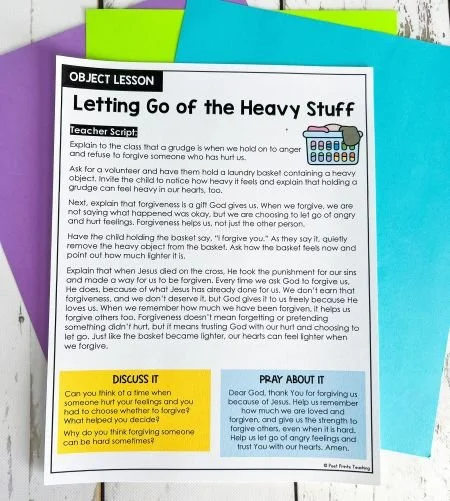
Object lessons are powerful because they take abstract ideas and make them concrete for kids. Forgiveness can be a hard concept to explain with words alone, but when children can see and feel something, it clicks. In the “Letting Go of the Heavy Stuff” object lesson, holding a laundry basket weighed down with a heavy object helps kids understand what it’s like to carry anger or a grudge. The physical weight gives language to a feeling many kids already know but may not know how to describe.

As the weight is removed, kids see that forgiveness can bring relief. This lesson connects directly to the Parable of the Unforgiving Servant by showing that forgiveness isn’t just a gift we give to someone else; it’s also a gift for the person doing the forgiving. When we hold on to anger, it weighs us down, but when we forgive, our hearts feel lighter. Because Jesus has forgiven us so much, we are free to let go of the heavy stuff and choose forgiveness too.

For a scripted object lesson, check out The Parable of the Unforgiving Servant for Older Kids.

A FORGIVING HEART CRAFT FOR PRESCHOOL

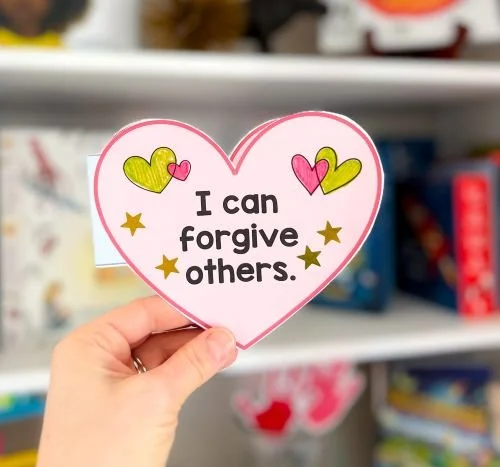
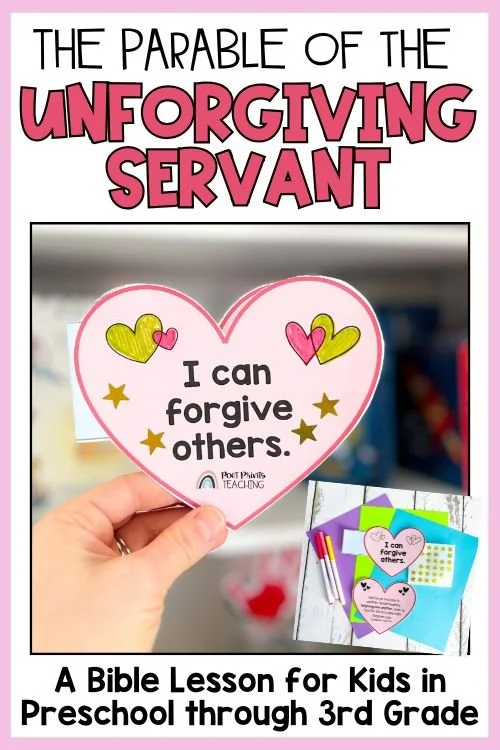
Simple crafts can have a powerful message. In this craft, kids will cut out two hearts and glue them using tabs so they can be opened like a book. One heart reads “I can forgive others,” and the other bears Ephesians 4:32: “Forgive one another, just as in Christ God forgave you” (NIV).

Once the hearts are assembled, the kids can decorate their little books however they would like. The template pieces can be found in The Parable of the Unforgiving Servant for Preschool.


A HEART THAT FORGIVES CRAFT FOR OLDER KIDS
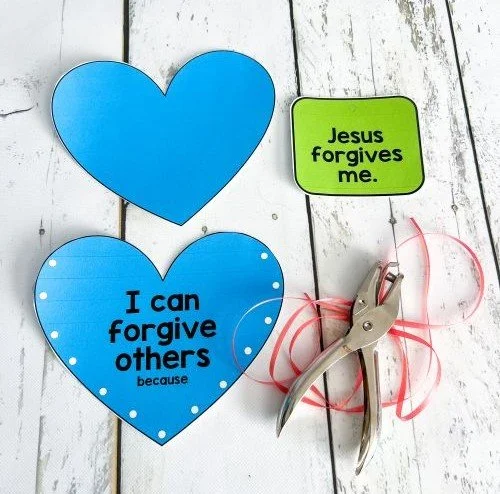
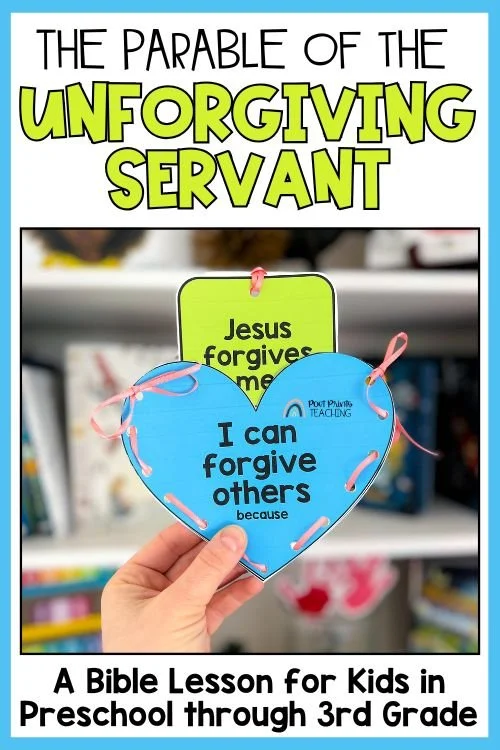
Older kids will do a lacing craft to remind them of the main idea from this lesson.

Older kids will enjoy the printable heart craft in The Parable of the Unforgiving Servant for Older Kids, where they use a hole punch along the edges of their heart pieces, then weave yarn in and out of the holes to sew the hearts together and create a pouch. 

As kids complete their craft, remind them that Jesus has forgiven us much, and that we can choose to forgive others, too! Forgiveness helps repair relationships and can make our hearts feel lighter. 


OTHER CRAFTS AND ACTIVITIES TO TEACH ABOUT THE UNFORGIVING SERVANT

  • For more ideas about teaching forgiveness, check out Forgiveness Bible Lessons for Kids.

  • Act it Out: Have kids take turns being the different people in the parable and act it out. Then act out real-life scenarios in which kids might need to show forgiveness. Model how to forgive. For example, saying “It’s OK” after someone apologizes isn’t very effective, because it wasn’t OK that someone wronged them. Instead, say, “I forgive you”.

  • Forgiveness Chain: Make a paper chain with kids. As you make the chain, talk about things that people do that might require forgiveness. For example, “someone pushed me on the playground”, or “someone took my cookie”. Then use scissors to cut the chain, symbolizing forgiveness for those who wronged us.

  • Make Erasers: Erasers are a great symbol of forgiveness, so why not make some erasers? Follow the instructions from Babble Dabble Do for how to make erasers using eraser clay.

YouTube videos about the unforgiving servant

YouTube can be a great resource for helping kids visualize a story. But be sure to preview all videos you plan to show to ensure they are age-appropriate and align with your teaching goals. Here are a couple of suggestions:


WANT TO CONTINUE LEARNING ABOUT THE PARABLES OF JESUS?

This lesson is part of a five-week series on the Parables of Jesus. The other lessons include The Parable of the Talents, The Parable of the Good Samaritan, The Parable of the Mustard Seed, and The Parable of the Great Banquet. 

And for more parable lessons, from an earlier parable series, check out Parable of Jesus for Older Kids and Parables of Jesus for Preschool.
The Parable of the Talents - Bible Lessons for Kids

Teaching the Parable of the Talents to kids is a meaningful way to help kids understand responsibility, faithfulness, and the wise use of God-given gifts. Bible-based ideas make this powerful story easy for children to grasp through printable lesson plans, engaging crafts, and hands-on activities that show how God calls each person to use what they have been given to honor Him and serve others.

WHAT IS A PARABLE?

A parable was a short story that Jesus used to teach people about God. These stories helped people understand what Jesus was saying because He connected them to people’s everyday lives. Parables can also be easier to remember than long speeches.

THE PARABLE OF THE TALENTS

The Parable of the Talents can be found in Matthew 25:14–30. It is also known as the Parable of the Three Servants.

In this parable, Jesus tells of a master who goes on a journey. Before leaving, he gives one servant five bags of money, another servant two bags of money, and a third servant one bag of money, each according to his ability. The first two servants put the money to work and earned five more bags and two more bags. The third servant dug a hole and hid his master’s money in the ground.

When the master returned, he settled accounts with the servants. The first two showed how the money had grown, and the master was pleased with them. The third servant explained that he hid the money, and the master was upset. The master took the bag of money from the third servant and gave it to the servant who had ten bags, and the unfaithful servant was punished.

Parable of the Talents - Bible Lessons for Kids

Are you looking for a simple way to teach kids about the Parable of the Talents? Be sure to check out our scripted lessons, discussion questions, and printable crafts. These resources are perfect for kids aged 3-8.

(Click HERE for the preschool/kindergarten version)

BACKGROUND INFORMATION ABOUT THE PARABLE OF THE TALENTS

In this parable, the word 'talent' refers to a specific amount of money. Scholars believe that a talent was about 50 pounds, but it could have weighed more! Talents are also special abilities that God has given us. God wants us to use the good gifts He has given us to help His Kingdom grow. 

We need to be like the first two servants in this parable, and not like the last servant who hid the money. God wants us to use our time, money, abilities, and intelligence to help people learn about Him. 

a treasure chest of talents

As we grow and get older, we will continue to discover our talents and gifts. It’s like God has put treasure inside us for us to discover! Some talents show up right away, and others will be discovered later. Our talents are treasures we can use to help God’s Kingdom. Kids will love this analogy!

Printable Treasure Chest for Preschool and Kindergarten

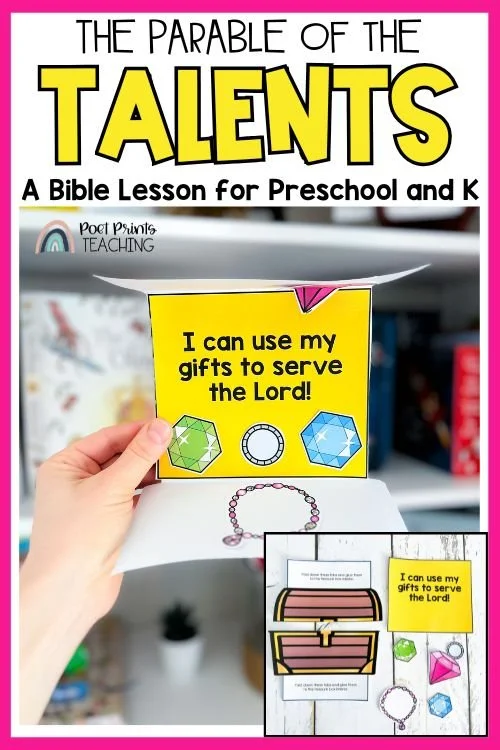
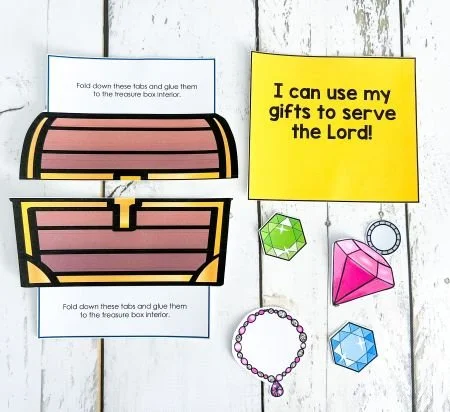
Make a printable treasure chest craft to help kids connect with this idea. Using the template pieces from The Parable of the Talents for Preschool, kids can assemble their paper treasure chest and decorate it with stickers, crayons, and the provided printable jewels. When they take their treasure chest home, it could spark great conversations in which kids share their talents with their families.

Print and Fold Treasure Chest for Bigger Kids

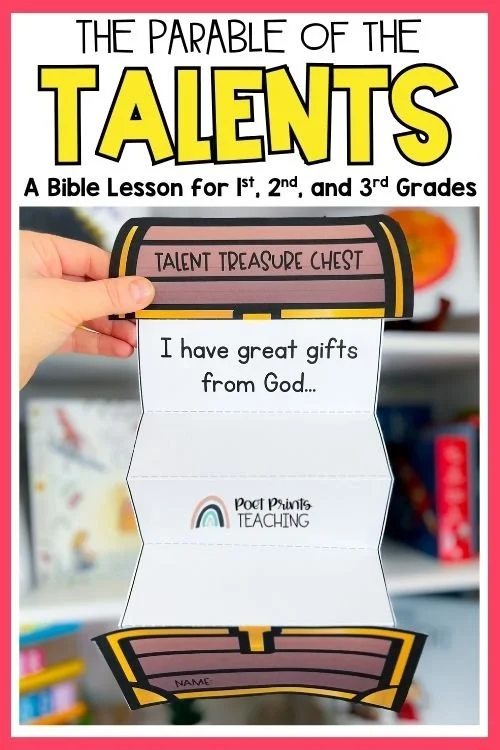
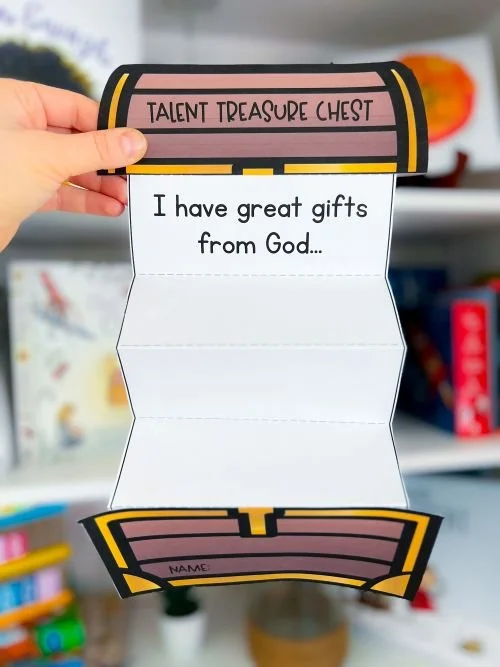
Older Kids will create a fold-out treasure chest to write or draw at least three talents God has given them. The template pieces can be found in The Parable of the Talents for Older Kids. After writing/drawing these ideas, kids can decorate their treasure chests with stickers, crayons, and the provided printable jewels. 

After doing the craft, remind kids that God wants us to use our gifts wisely. Our talents are valuable and can be used to serve God and bless others. 


OTHER CRAFTS AND ACTIVITIES TO TEACH ABOUT THE PARABLE OF THE TALENTS

  • Talent Coins: Brainstorm with kids about different talents that God has given them. This could be “I am kind”, “I am good at listening”, “I am good at soccer”, etc. Then have kids write these on small circular pieces of paper (to look like coins from the parable). Put these in an envelope that kids can decorate.

  • Talent Gift Box: Purchase wooden or paper boxes from the Dollar Store. Have children decorate these boxes with paint, markers, stickers, glitter, etc. Next, have kids write some of their different talents on slips of paper. They can place these talents in the box as a reminder that they are a gift from God and should be used wisely.

  • Grow Your Talents: Challenge kids to pick one talent they want to put into practice this week, something they want to get better at and use to glorify God. Help kids come up with a “game plan” to put their talent into action and practice.

YOUTUBE VIDEOS ABOUT THE PARABLE OF THE TALENTS

Take some time to watch a YouTube version of the Parable of the Three Servants. This will likely help kids visualize the story better. But before showing any videos, be sure to preview them. Here are a few suggestions:


WANT TO CONTINUE LEARNING ABOUT THE PARABLES OF JESUS?

This lesson is part of a five-week series on the Parables of Jesus. The other lessons include The Parable of the Mustard Seed, The Parable of the Good Samaritan, The Parable of the Unforgiving Servant, and The Parable of the Great Banquet. 

And for more parable lessons, from an earlier parable series, check out Parable of Jesus for Older Kids and Parables of Jesus for Preschool.
The Parable of the Mustard Seed - Bible Lessons for Kids

Teaching the Parable of the Mustard Seed to kids is a wonderful way to help them understand how God can use even the smallest faith to do big things. Simple, Bible-based ideas bring this short but powerful story to life through engaging lesson plans, hands-on craft ideas, and interactive activities that help children see how their faith can grow and make a difference in everyday life.

WHAT IS A PARABLE?

A parable was a short story that Jesus used to teach people about God. These stories helped people understand what Jesus was saying because He connected them to people’s everyday lives. Parables can also be easier to remember than long speeches.


THE PARABLE OF THE MUSTARD SEED

The Parable of the Mustard Seed can be found in Matthew 13:31–32, Mark 4:30–32, and Luke 13:18–19. In this parable, Jesus says the Kingdom of God is like a mustard seed that a man took and planted in his garden. Then it grew into a tree, and birds made homes in its branches.

Parable of the Mustard Seed Bible Lessons for Kids

Are you looking for an easy and effective way to teach about the Parable of the Mustard Seed? Be sure to check out our scripted lesson, printable crafts, and discussion questions. Perfect for kids aged 3-8.

(Click HERE for the 1st, 2nd, 3rd grade version)

BACKGROUND INFORMATION ABOUT THE PARABLE OF THE MUSTARD SEED

In this parable, Jesus compares the Kingdom of God to a mustard seed. A mustard seed is very small. It's about the size of a grain of sand. Even though the seed is so small, it grows into a tall tree. Mustard trees usually grow between 6 and 12 feet tall. Sometimes, even as tall as 15-20 feet.

The Kingdom of God is anywhere God is King, so this isn’t a specific place.

God's Kingdom grows when more people join God's family. Small seeds of faith can grow into something big in God's Kingdom. These small acts might be telling someone about Jesus, serving others, forgiving someone, or showing kindness to someone. 


SEEDS OF FAITH - PRINTABLE CRAFT FOR PRESCHOOL

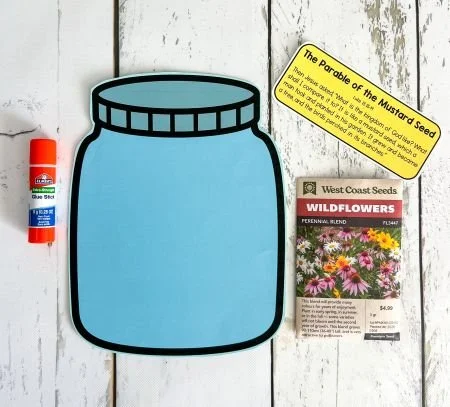
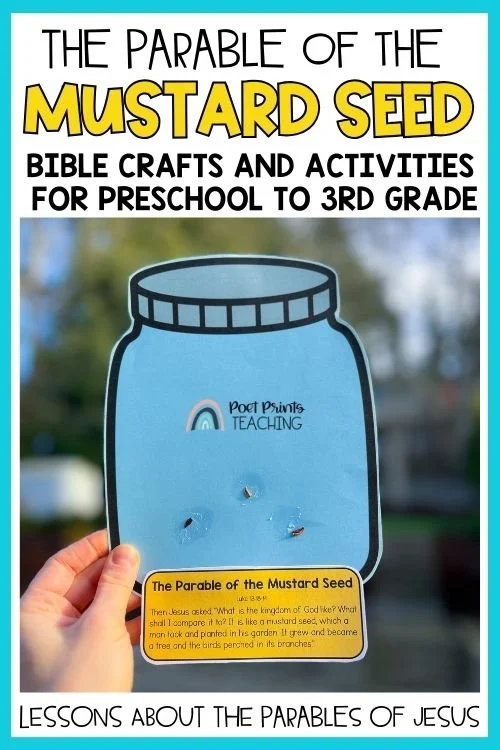
Kids in preschool and kindergarten will decorate this printable jar and glue on real seeds to remind them of the parable.

A simple printable craft can serve as a great connecting activity when teaching Bible stories. Crafts can also serve as conversation starters at home, helping parents understand what their children are learning in class.

For this craft, kids will glue seeds onto a paper template of a jar. To start, kids will cut out and decorate their jar. Then give each child a few seeds to glue into their jar. They will also glue a printable verse onto the jar to remind them of the story. For template pieces, check out The Parable of the Mustard Seed for Preschool.

MUSTARD TREE CRAFT FOR OLDER KIDS

Older kids will create a visual recreation of the parable.

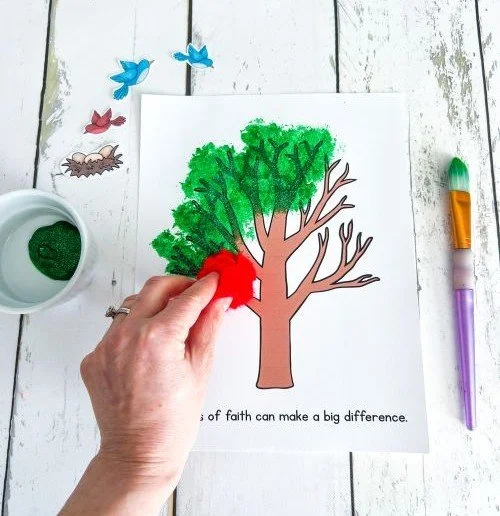
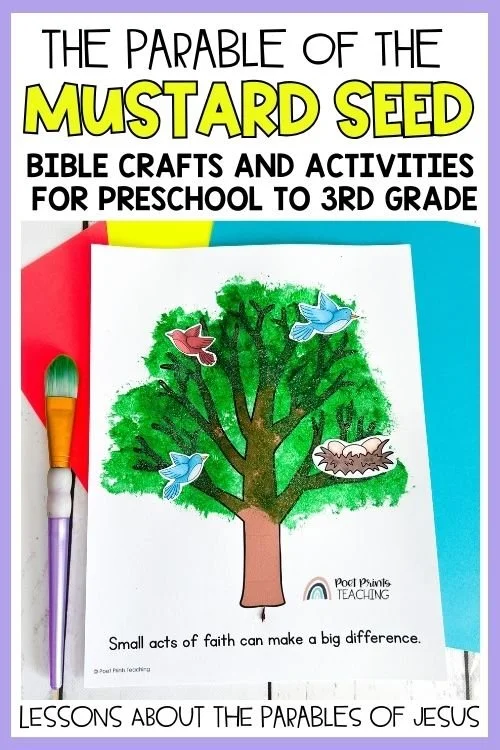
Older kids will enjoy painting a mustard tree using the template from The Parable of the Mustard Seed for Older Kids. Use a sponge or a pompom to have kids dab paint onto their tree. Once the paint is dry, add the paper nest and bird pieces to the tree. Kids can even glue a small seed to the base of the tree to remind them that seeds are very small, but grow into something big.

Be sure to help kids see that even small acts of faith can have a big impact on the Kingdom of God.


OTHER CRAFTS AND ACTIVITIES TO TEACH ABOUT THE PARABLE OF THE MUSTARD SEED

  • Salt Dough Seed Art: Make salt dough ornaments by pressing seeds of various sizes into the dough to create a pattern or picture. Use popcorn, pumpkin seeds, sunflower seeds, chia seeds, etc. Then let kids get creative with their patterns and art. Make sure to put a hole in the salt dough before it dries so kids can string it and hang it as an ornament somewhere in their house. For a simple salt dough recipe, check out Yummy Toddler Food.

  • Seed Mosaic: Check out First Palette for beautiful seed mosaic instructions. Kids will love creating pictures using paper, glue and seeds.

  • Mustard Seed Visual: Compare various seeds so kids can see just how small a mustard seed is compared to others. Take this one step further and have kids glue various-sized seeds onto a piece of paper, then write the verse: “Faith as small as a mustard seed can move mountains.” 

  • Make Necklaces or bracelets: Find small beads and have kids string them into a necklace or bracelet. The small beads will serve as a visual reminder that even small steps of faith make a big difference. 

YOUTUBE VIDEOS ABOUT THE PARABLE OF THE MUSTARD SEED

Even though this is a short parable, there is still value in watching a video about it. Be sure to preview any video you intend to show your kids. Here are a couple suggestions:

WANT TO CONTINUE LEARNING ABOUT THE PARABLES OF JESUS?

This lesson is part of a five-week series on the Parables of Jesus. The other lessons include The Parable of the Talents, The Parable of the Good Samaritan, The Parable of the Unforgiving Servant, and The Parable of the Great Banquet. 

And for more parable lessons, from an earlier parable series, check out Parable of Jesus for Older Kids and Parables of Jesus for Preschool.
The Parable of the Great Banquet - Bible Lessons for Kids

Teaching kids the Parable of the Great Banquet is a meaningful way to help them understand God’s invitation, grace, and the joy of being welcomed into His kingdom. There are many creative, kid-friendly ideas to bring this powerful Bible story to life through printable lesson plans, hands-on crafts, and activities that help children grasp the message that God invites everyone to accept His invitation.

WHAT IS A PARABLE?

A parable was a short story that Jesus used to teach people about God. These stories helped people understand what Jesus was saying because He connected them to people’s everyday lives. Parables can also be easier to remember than long speeches.

THE PARABLE OF THE GREAT BANQUET

The Parable of the Great Banquet can be found in Luke 14:15-24. Jesus teaches that a man prepared a great banquet and invited many guests. When the time for the banquet came, the invited guests made excuses and did not come. The excuses sounded important, like getting married, buying new land, and buying new oxen.

But the master became upset when he heard this and sent his servant to invite the poor, crippled, blind, and lame instead. When he discovered there was still room at the banquet, he invited even more people. And those who were originally invited did not get to come to the banquet.

The Parable of the Great Banquet for Kids

Are you looking for an easy and effective way to teach about the Parable of the Great Banquet? Be sure to check out our scripted lessons, printable crafts and discussion questions.

(Click HERE for the preschool/kindergarten version!)

BACKGROUND INFORMATION ABOUT THE GREAT BANQUET

In this parable, the master of the house represents God, and the feast represents God's kingdom. The people originally invited to the feast represent anyone who thought they were automatically part of God's Kingdom, not realizing they needed to accept the invitation first. This included many of the Pharisees and religious leaders.

Daily activities and excuses can distract us from accepting God's invitation. God's invitation to be part of His Kingdom is for everyone, and it’s important that we don’t miss it because we’re too busy and distracted.

INVITATIONS TO GOD’S KINGDOM CRAFT FOR PRESCHOOLERS

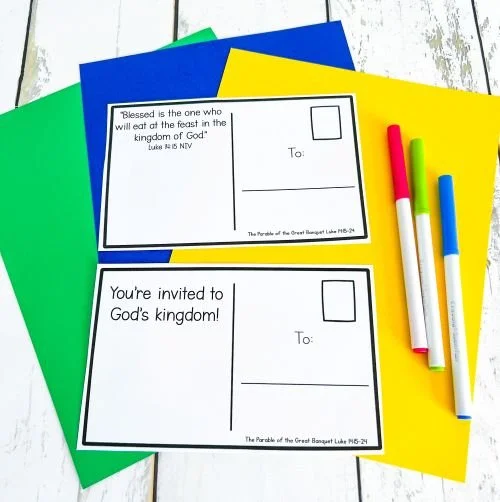
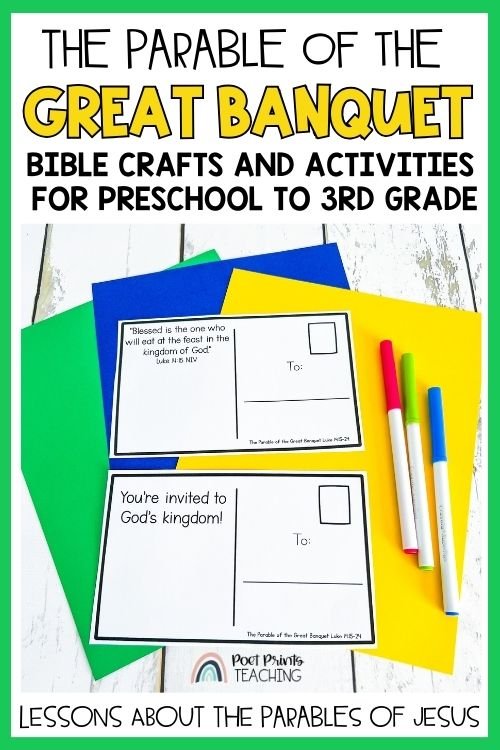
Little kids will make postcard invitations as a reminder that they’re invited to God’s kingdom!

Receiving an invitation is really exciting, especially for preschoolers. Getting invited to a party is a huge deal!

Kids in preschool and kindergarten will be very familiar with the concept of an invitation, so take time to decorate invitations with crayons, stickers, glitter, and other materials.

These invitations are inviting people to join God’s Kingdom! Kids can keep the invitations as a reminder of the lesson, or give them out to a friend or neighbor.

For a printable template, check out The Parable of the Great Banquet for Preschoolers. 

SETTING THE TABLE PRINTABLE CRAFT FOR OLDER KIDS

Older kids will make this fun place setting craft.

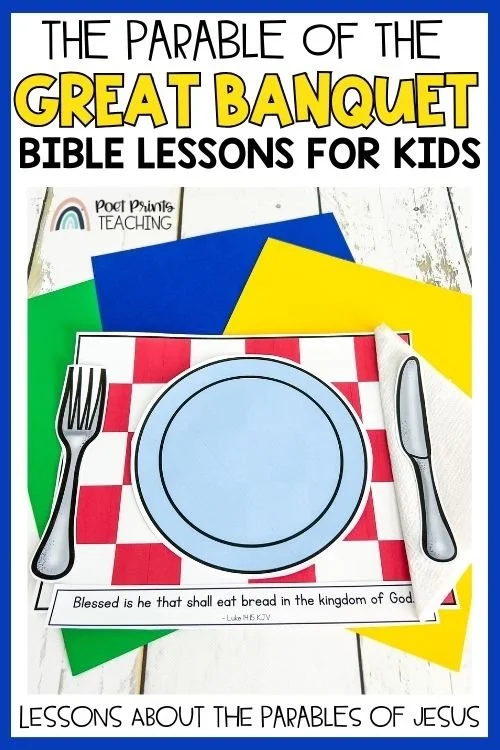
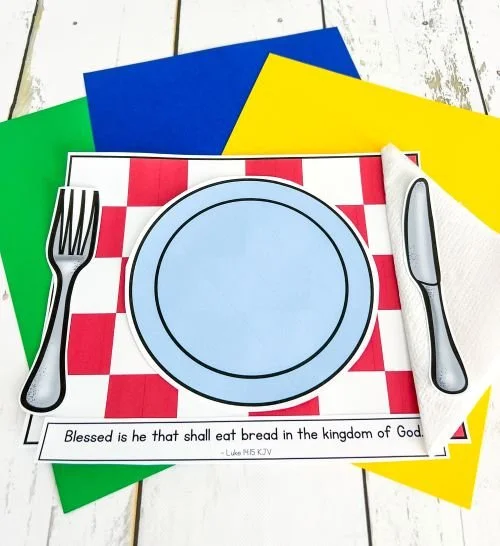
A banquet is an incredible feast and requires preparation. One of the things that needs to be done before the banquet is setting the table. In this printable craft from The Parable of the Great Banquet for Older Kids, kids will use the template pieces to create a table setting. 

After kids create their craft, be sure to connect back to the story. Jesus taught that God invites everyone to be part of His Kingdom. Just as places are set at the table for guests, God is preparing a place for those who accept his invitation. 


OTHER CRAFTS AND ACTIVITIES TO TEACH ABOUT THE GREAT BANQUET

  • Banquet Snack: Tell the story while sitting around a “banquet” snack. Set up a long table and, if possible, set it to look like a party. Then share a snack and tell the story. 

  • Banquet Table Scene: Use a roll of paper and cut a piece to be the length of a table. Tape the paper to a long table, then have kids work together to draw various foods that might be at the banquet. 

  • Banquet Relay: Create relay races that connect to preparing or attending the banquet. Kids can race to carry items like paper plates, napkins, or pretend food to a table, or run one at a time to the table as “guests” arriving at the banquet.

  • Excuses, Excuses: Have kids brainstorm excuses that someone might make when they don’t want to go to a party. Then have a conversation about how God has invited us into His Kingdom, and we don’t want to make excuses.


YOUTUBE VIDEOS ABOUT THE PARABLE OF THE GREAT BANQUET

Using videos is a great way to bring Bible stories to life for kids, especially those who learn best by seeing. Always take a moment to watch the videos beforehand to ensure they are suitable for your group. Below are a couple of helpful options to consider:


WANT TO CONTINUE LEARNING ABOUT THE PARABLES OF JESUS?

This lesson is part of a five-week series on the Parables of Jesus. The other lessons include The Parable of the Talents, The Parable of the Good Samaritan, The Parable of the Mustard Seed, and The Parable of the Unforgiving Servant. 

And for more parable lessons, from an earlier parable series, check out Parable of Jesus for Older Kids and Parables of Jesus for Preschool.
The Parable of the Good Samaritan - Bible Lessons for Kids

Teach children the powerful message of love, compassion, and kindness through the Parable of the Good Samaritan, using engaging, age-appropriate ideas that bring this timeless Bible story to life. There are many meaningful ways to guide kids in understanding what it means to love their neighbor, show mercy to others, and live out their faith through everyday actions, using hands-on lessons, creative activities, and thoughtful discussion rooted in Scripture.

WHAT IS A PARABLE?

A parable was a short story that Jesus used to teach people about God. These stories helped people understand what Jesus was saying because He connected them to people’s everyday lives. Parables can also be easier to remember than long speeches.

THE PARABLE OF THE GOOD SAMARITAN

The parable of the Good Samaritan appears in Luke 10:25-37. Jesus taught this parable in response to a man asking Jesus, “Who is my neighbor?” Jesus told this story. A Jewish man was travelling from Jerusalem to Jericho. Along the way, he was beaten, robbed, and left by the side of the road.

Soon, a priest came by, but passed the man on the other side of the road. Later, a Levite came along and also passed the injured man on the other side of the road. Finally, a Samaritan came by. He took pity on the man. He cared for the man’s wounds, put him on a donkey, and brought him to an inn, where he cared for the man. The next morning, he gave the innkeeper two coins and asked him to care for the man, promising to reimburse any extra expenses. 

The Good Samaritan Bible Lessons for Kids

If you’re looking for an easy and effective way to teach about the Good Samaritan, be sure to check out our scripted lessons, printable crafts and discussion questions.

(Click HERE for the preschool/kindergarten version!)

BACKGROUND INFORMATION ABOUT THE GOOD SAMARITAN

When Jesus told this story, it would have been a surprise that the priest and Levite didn’t help the man, yet the Samaritan did. Priests and Levites were religious leaders and had a duty to help people. But these men made excuses instead of helping. Samaritans, on the other hand, were enemies of the Jews. Jewish people went out of their way to avoid Samaritans. So the fact that it was a Samaritan would have been shocking.

This story is a powerful reminder that God calls us to love ALL people, not just our friends. We are to show love and kindness to everyone. This includes people who look different, act differently, and people who don’t like us.

BOX OF KINDNESS CRAFT FOR OLDER KIDS

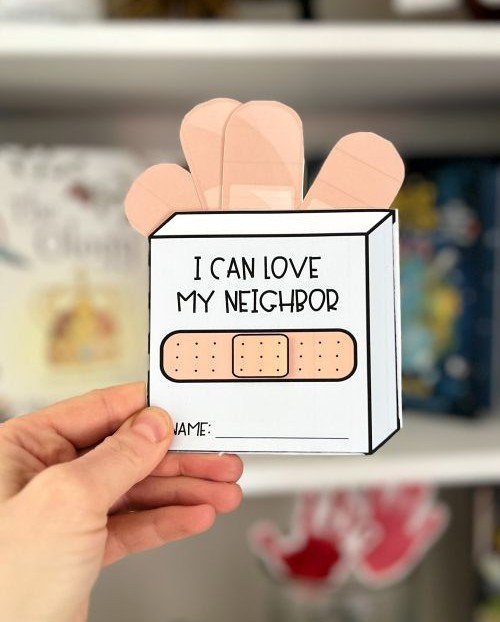
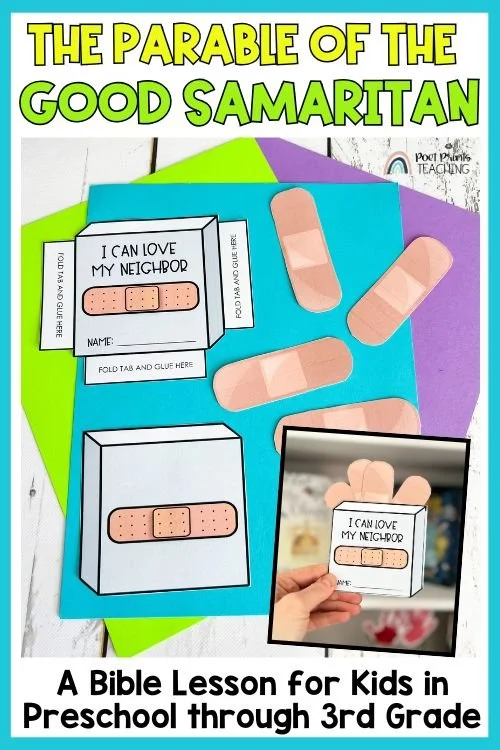
Older kids will build a small box to hold bandages full of kindness ideas!

Take time to brainstorm realistic ways kids can show love and care to their neighbors. These could be everyday things that happen at school, home, or the playground. For example, helping someone who is hurt, inviting someone to play if you see they are alone, or sharing your cookie with a sibling.

Then turn these brainstormed ideas into a visual reminder by creating a Kindness Box. Kids will cut out and assemble the bandage box and write different ways to show love on each bandage. This printable craft, included in the Parable of the Good Samaritan for Older Kids, serves as a reminder to act like the Good Samaritan.

BANDAGE HIM UP CRAFT FOR PRESCHOOLERS

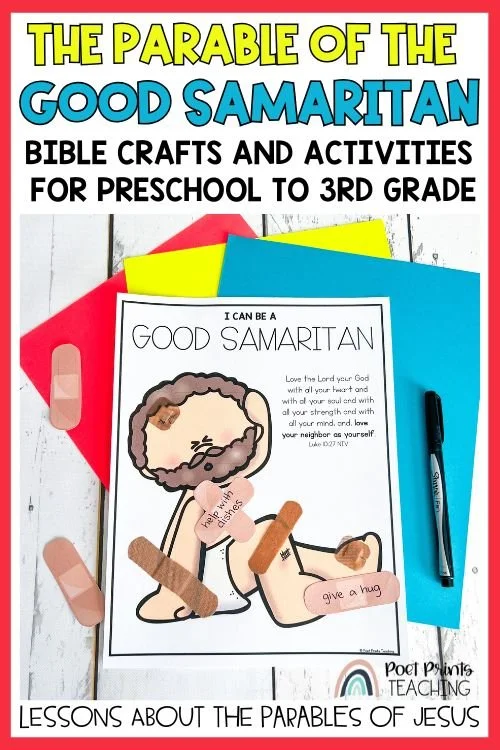
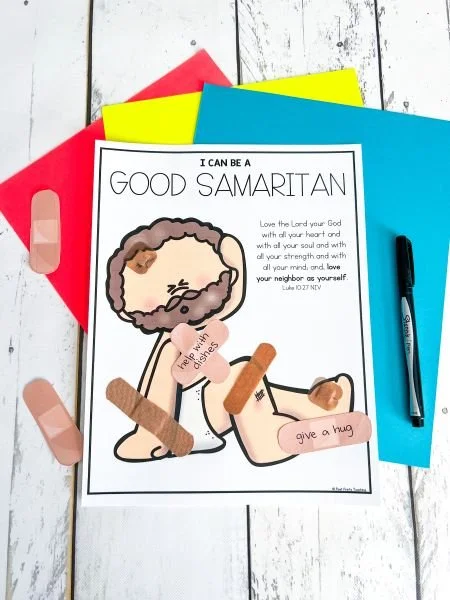
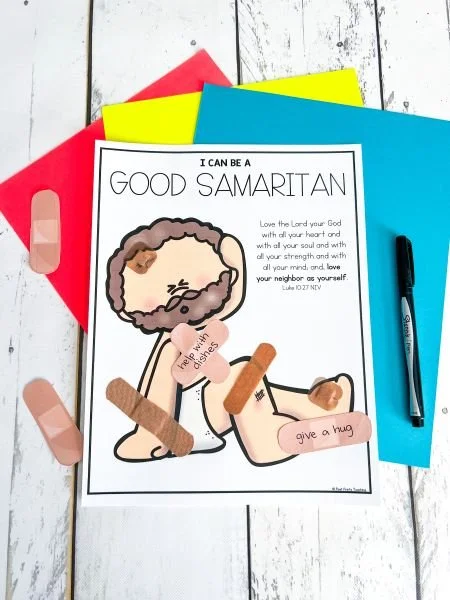
Younger kids will add bandages to a picture of the man on the road and talk about ways to love their neighbors.

Doing an activity with Band-Aids is a great way for little learners to connect with the story of the Good Samaritan. There is something about peeling and sticking Band-Aids that captures preschoolers' hearts. After reading the story of the Good Samaritan, give children a printable version of the injured Jewish Man, which you can find in The Parable of the Good Samaritan for Preschoolers.

Then give the kids Band-Aids to stick over the man. If you would prefer, there are also printable Band-Aids that kids can cut out and paste onto the man. 

While this activity is simple, it can be a powerful reminder of showing kindness and love to those around us. Encourage the children to draw a picture of something that they can do to show love to their neighbor.  

ACT IT OUT FOR PRESCHOOLERS

Many kids enjoy acting out stories and moving around when a story is being told. Having kids act out the parable of the Good Samaritan will also help solidify the story in their memories.

Read the story of the Good Samaritan from your children’s Bible, or use the script provided in The Parable of the Good Samaritan for Preschoolers. As you read, ask kids to do the actions for each moment in the story. Getting kids’ bodies up and moving is a great way to help the story ‘stick’ in their minds.

OTHER CRAFTS AND ACTIVITIES TO TEACH ABOUT THE GOOD SAMARITAN

  • For more ideas about teaching the Good Samaritan, check out Kindness Bible Lessons for Kids.

  • Good Samaritan Obstacle Course: Create a simple obstacle course using materials in your room. Then put stuffed animals or figures in the obstacle course. Kids have to collect the stuffed animals or figures while they go through the obstacle course. Connect this to the parable: stopping to help isn’t always convenient.

  • Helping Hands Craft: Have kids trace their hands (as many as they would like). Write ideas on each hand for how they can show kindness and love to those around them. Then glue the hands onto a large piece of paper so the kids can take it home more easily.

  • The Road to Jericho Game: Use painter’s tape to make a road on the ground. Then have kids line up on one end of the road. Put a stuffed animal or figure on the side of the road to be the injured Jewish man. If you say, “stop to help”, the kids have to stop and help the injured man. If you say, “cross to the other side”, the kids have to move to the other side of the road and pass by.

  • Kindness Challenge Jar: Write some ideas of how to show kindness on slips of paper, and then put them all in a jar. At the start of the week, have kids pull one of the papers and challenge them to do that act of kindness at some point throughout the day or week.

videos to teach the parable of the GOOD SAMARITAN

Watching videos can be an effective way to help kids learn Bible stories, especially for visual learners. Be sure to preview any videos you intend to show to ensure they are age-appropriate. Here are some suggestions:

WANT TO CONTINUE LEARNING ABOUT THE PARABLES OF JESUS?

This lesson is part of a five-lesson series on the Parables of Jesus. The other lessons include The Parable of the Talents, The Parable of the Unforgiving Servant, The Parable of the Mustard Seed, and The Parable of the Great Banquet. 

And for more parable lessons, from an earlier parable series, check out Parable of Jesus for Older Kids and Parables of Jesus for Preschool.
The Parable of the Lost Sheep, Bible Lesson for Kids

Are you ready to learn about God’s great love for us through the parable of the Lost Sheep? Whether you're a Sunday school teacher, homeschooling parent, or work in a faith-based school, there are many engaging activities, crafts, videos, and printable lesson plans to bring this powerful parable of Jesus to life! Keep reading for easy-to-use resources to make teaching about The Lost Sheep meaningful and fun for kids in preschool through third grade.

THE parable of the lost sheep

The Parable of the Lost Sheep is found in Luke 15:3-7 and Matthew 18:12-14. A man had 100 sheep, and one was missing. He left the 99 sheep and searched for the one lost sheep. When he found the sheep, he rejoiced and invited all his friends to celebrate with him.

The Parable of the Lost Sheep - Bible Lessons for Kids

Are you looking for a simple way to teach the Parable of the Lost Sheep? Our scripted lesson plans, discussion questions, and printable crafts are perfect for children aged 3 to 8.

(Click HERE for the 1st, 2nd, and 3rd grade version)

BACKGROUND INFORMATION ABOUT THE PARABLE OF THE LOST SHEEP

In this parable, God is the Shepherd, and we are the sheep. The Shepherd rejoices more over the lost sheep being found than the 99 sheep who never strayed. This parable teaches us that God rejoices when a sinner returns to Him.

The Pharisees would have seen themselves as part of the 99 who didn’t stray. It would have been shocking for them to hear that God rejoices more over sinners than over them. The Pharisees had a big problem with pride and thought they were better than others. 

SHEPHERD OR SHEEP? - ACTIVITY FOR OLDER KIDS

A shepherd cares for the sheep and fights off danger. To protect the sheep, shepherds sleep in the pen entrance at night. They build dams to slow the water in streams and rivers so it is easier for the sheep to drink. 

On the other hand, sheep cannot protect themselves, can’t hear very well, have bad eyesight, and get easily confused. They need a shepherd.

Turn these facts (and others) into a sorting activity. Have kids sort out cards with facts about shepherds and sheep into the appropriate categories. Then, discuss how we are like sheep and God is like the Shepherd. Check out The Parable of the Lost Sheep for Older Kids for sorting cards with facts about sheep and shepherds.

HOW TO DRAW A SHEEP ACTIVITY FOR OLDER KIDS

‘How to Draw a Sheep’ activity for kids in 1st, 2nd, and 3rd grades.

Learning to draw a sheep is a great way to make an artistic connection to this parable.

There are some adorable animated sheep out there. So why not teach your kids some step-by-step sheep drawings? Art Hub for Kids has a couple: How to Draw a Sheep for Preschool and How to Draw a Cartoon Sheep.

Or, if you prefer printable instructions, use the step-by-step printable instructions in The Parable of the Lost Sheep for Older Kids.

After drawing one sheep, challenge kids to draw more. After all, there are technically 100 sheep in this story!

Sheep and Shepherd Craft for Younger Kids

Cotton balls are a great way to give a sheep craft extra texture. Grab a bag or two from the store and let kids add them to their sheep crafts. This fun addition makes their creations look and feel more like real sheep.

Using the template pieces in The Parable of the Lost Sheep for Preschool, have kids color and cut out their shepherd and sheep pieces. Then use glue and cotton balls to give their sheep fluffy wool. They will love this simple, soft craft! As they create, encourage them to imagine how happy the shepherd must have been to find his lost sheep.

OTHER ACTIVITIES TO TEACH THE PARABLE OF THE LOST SHEEP

  • Find the Lost Sheep: Either print out pictures of sheep or get little sheep figurines or stuffed animals. Then, hide them around the room for kids to find. 

  • Paper Plate Sheep Craft: Use a paper plate, cotton balls, googly eyes, and glue to create the cutest sheep craft! Check out This Craft Family for step-by-step instructions to make a paper plate sheep.

  • “Shepherd Says”: This game is similar to “Simon Says,” but uses the phrase “Shepherd says” instead. The leader is the shepherd, and the other kids are the sheep. The ‘shepherd’ will give simple instructions for the ‘sheep’, such as “Shepherd says walk to the walk” or “Shepherd says jump on your foot.”

  • Shepherd Mazes: Create an obstacle course using objects like tables, chairs, blankets, pillows, etc. Then, have kids do a “Follow the Leader” style game in which they follow the “shepherd” through the maze. The kid who is the shepherd gets to choose how the “sheep” maneuver around each object. For instance, they might go under the table and over the chairs.

YOUTUBE VIDEOS ABOUT THE PARABLE OF THE LOST SHEEP

YouTube is a great resource! But be sure to preview any videos you intend to show your kids for age-appropriateness and content. Here are some video suggestions:

WANT TO CONTINUE LEARNING ABOUT THE PARABLES OF JESUS?

This lesson is part of a five-week series on the parables Jesus told. The other stories include The Wise and Foolish Builders, The Lost Coin, The Parable of the Sower, and The Prodigal Son.

These lessons about the Parables of Jesus are also included in the 52-week Bible curriculum for little kids in preschool/kindergarten and bigger kids in first, second, and third grades.

Teaching the Parable of the Lost Sheep in a creative and engaging way helps children understand God’s deep love and desire to bring everyone back to Him. 

The Parable of the Prodigal Son, Bible Lesson for Kids

The Parable of the Prodigal Son is a powerful way to illustrate God’s love, forgiveness, and grace. Engaging activities can bring this parable of Jesus to life, whether you're a Sunday school teacher, homeschooling parent, or work in a faith-based school. Explore craft ideas, fun games, YouTube video recommendations, and printable lesson plans to help children understand and connect with this story of a father’s love for his son.

What’s the parable of the prodigal son about?

The Prodigal Son is found in Luke 15:11-32. It’s the story of a man with two sons. The younger son asked his father for his share of the family’s money, then squandered all the money on foolish things.

Now destitute, the younger son asked a farmer if he could work in the field and care for the pigs. At one point, the son looked at the pig slop and considered eating it. Finally, the son returned home, hoping to become a servant in his father’s house. Instead, he was welcomed with an embrace and a party.

The older son, on the other hand, served his father faithfully. But when his younger brother returned home, he became bitter and jealous that a party was thrown for his younger brother.

The Parable of the Prodigal Son Bible Lessons for Kids

Are you looking for a simple way to teach the Parable of the Prodigal Son? Our scripted lesson plans, discussion questions, and printable crafts are perfect for children aged 3 to 8.

(Click HERE for the Preschool/Kindergarten Version)

PRODIGAL SON VS. LOST SON

Different Bible translations use different titles for this parable. Translations like the King James Version, the New King James Version, and the English Standard Version call it The Parable of the Prodigal Son. Other translations like New International Version, New Living Translation, and Christian Standard Bible call it The Parable of the Lost Son. 

“Prodigal” comes from the Latin word prodigus, which means “wasteful” or “extravagant”. “Lost” aligns with the other parables in Luke 15: the lost coin and lost sheep. Both descriptions accurately describe the son and point to different aspects of the story. 

BACKGROUND INFORMATION ABOUT THE PRODIGAL SON

In this parable, the father represents God. And the two sons represent people.

We might be like the younger son and try to do things our own way. Or we might be like the older son and do things God’s way but have negative things in our hearts.

God knows we will mess up, and He is patient with us. Like the father in the story, God will always forgive us when we return to him, and welcome us home with open arms.

WELCOME HOME HUG CRAFT FOR OLDER KIDS

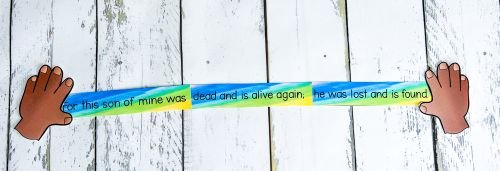
The father welcomed the prodigal son home with a giant hug. So, why not create a simple “hug” craft? First, have kids trace their hands. They might need a partner to trace their non-dominant hand for them. You can also use the hand template pieces in The Prodigal Son for Older Kids

Next, have kids cut and color the three pieces of their verse: For this son of mine was dead and is alive again; he was lost and is found.

Kids will glue these strips together and then glue those between their cut-out hands to show outstretched hands for a hug.

Two hands are pictured far apart with a long colorful strip between them. The strip reads, "For this son of mine was dead and is alive again."

A printable craft to accompany the Parable of the Prodigal son.

COMING HOME CRAFT FOR YOUNGER KIDS

In this printable craft, kids will slide the son back home to the father!

Younger kids will love creating an interactive craft where the prodigal son is glued to a popsicle stick. Using the template pieces in The Prodigal Son for Preschool, have kids color their pieces. You will likely have to help with the cutting aspects of this craft (or enlist older kids to pre-cut the pieces) because some of the cutting is delicate - especially the slit in the middle of the page. 

Once the pieces are all cut and colored, glue the prodigal son to the popsicle stick and insert him into the slit in the scene. Slide the prodigal son along the slit to show him running home to the father.

OTHER ACTIVITIES TO TEACH THE PARABLE OF THE PRODIGAL SON

  • Welcome Home Banners: Have kids create welcome home banners or signs as a reminder that God always welcomes and forgives us when we return to him, just like the prodigal son returned to his father.

  • Pig Slop Relay: You could create fun relays to recreate life in the pig pen. Create a relay race where kids have to use a spoon to carry objects like pompoms, Cheerios, rice grains, etc., from one bowl to another. Or, if you can be outside, have kids use a sponge to transport water from one bucket to another. This will be messy…kind of like living in a pig pen. 

  • Pig Pen Snack: Use chocolate pudding, crushed cookies, and candies to create a fun snack for kids. Kids have great imaginations, and seeing the pudding as mud wouldn’t be a stretch.

  • Piggy Banks: Have kids decorate and paint a piggy bank. Then, encourage them to make wise choices with their money, unlike the prodigal son. Dollar stores often have inexpensive piggy banks in their craft sections. 

YOUTUBE VIDEOS ABOUT THE PARABLE OF THE PRODIGAL SON

This is a powerful story about God’s great love for us, and many kids would love to see it in video form. Below are some suggestions. Please preview any videos you show for age-appropriateness and content.

WANT TO CONTINUE LEARNING ABOUT THE PARABLEs OF JESUS?

This lesson is part of a five-week series on the parables Jesus told. The other stories include The Wise and Foolish Builders, The Lost Sheep, The Lost Coin, and The Parable of the Sower.

These lessons about the Parables of Jesus are also included in the 52-week Bible curriculum for little kids in preschool/kindergarten and bigger kids in first, second, and third grades.

The Prodigal Son is a beautiful story about God’s love and forgiveness. People love this story and can often picture themselves as one of the sons. There are many ways to help engage kids in this story and make it memorable.

The Parable of the Wise and Foolish Builders, Bible Craft and Lesson

Look no further for creative ways to teach the Parable of the Wise and Foolish Builders! This powerful Bible story about two builders teaches kids the importance of building their lives on a strong foundation—God’s Word. There are many great ways to teach this parable, including engaging crafts, hands-on activities, and fun YouTube videos that bring the lesson to life. Plus, you’ll find printable lesson plans to make your teaching even easier. Whether you're a Sunday school teacher, homeschooling parent, or work in a faith-based school, these ideas will help kids understand and remember this important parable.

THE parable of the two builders

The Parable of the Wise and Foolish Builders is found in Matthew 7:24-27 and Luke 6:46-49.  Jesus tells the story of two men who each build a house. One man builds on rock, and when a storm comes, the house stands firm. The other man builds on sand, and when a storm comes, the house collapses.  

The Parable of the Two Builders Bible Lessons for Kids

Are you looking for a simple way to teach the Parable of the Wise and Foolish Builders? Our scripted lesson plans, discussion questions, and printable crafts are perfect for children aged 3 to 8.

(Click HERE for the 1st, 2nd, and 3rd grade version!)

BACKGROUND INFORMATION ABOUT THE WISE AND FOOLISH builders

A parable is a short story that Jesus used to teach people about God. These stories helped people understand what Jesus was saying because Jesus connected the stories to people’s everyday lives. Parables are also easier to remember than long speeches. 

This parable isn’t really about building a strong home. It’s about building a strong relationship with Jesus and listening to his teachings. While it’s great to go to church, sing worship songs, pray, and read the Bible, we must also follow what Jesus instructs us to do - love God and love others. Our actions need to match what Jesus instructs. 

BUILDING CHALLENGES FOR KIDS

A 'Building Challenge' worksheet is pictured on a table next to some mini marshmallows and toothpicks.

This building challenge worksheet will help bigger kids to plan their toothpick and marshmallow structures.

Kids of all ages love a good building challenge. In this Parable of the Two Builders challenge, you’ll ask the younger kids in your class to build a small house that stands on its own. Keep the challenge open-ended and allow them to build with whatever materials you might have on hand. These could be materials like paper, tape, pipe cleaners, cardboard, popsicle sticks, etc. You could keep it even simpler and have them build something using blocks or magnetic tiles.

Make the challenge a little trickier for older kids in first, second, or third grades. These tiny builders can use toothpicks and marshmallows to create a sturdy structure! Have kids use the planning sheet in The Wise and Foolish Builders for Older Kids to get their ideas on paper. Then, they can revisit the planning sheet as they create.

PRINTABLE CRAFTS FOR KIDS

A printable brick house is pictured on top of a grass/rock foundation. The text reads, "I will build my house on the rock."

A printable craft to accompany the Parable of the Wise and Foolish Builders

Printable crafts are great because kids can bring them home to help them retell the story to their families and caregivers. They are also an excellent way for students to visualize the story.

Preschoolers will love gluing a printable house onto solid ground (Find the template pieces in The Wise and Foolish Builder for Preschool).

This simple craft reminds young kids that their home needs to be built on solid ground. Encourage young learners to understand that their faith should be placed in Jesus, the true and lasting Rock, who provides strength, security, and guidance in every season of life!

Older kids will appreciate a slightly more complex lift-the-flap booklet from The Wise and Foolish Builder for Older Kids. Kids will cut and fold the template pieces on the appropriate lines to construct their booklets. Once completed, the front of the craft shows the house built by the foolish man, and kids lift the flaps to see the one built by the wise man. This interactive craft helps reinforce the lesson by providing a hands-on way to visualize the parable’s key message: Listening to God’s Word is wise!

OTHER ACTIVITIES TO TEACH THE PARABLE OF THE WISE AND FOOLISH BUILDER

  •  Building Relays: Kids love a good relay race, so why not combine relay races with building challenges? Have kids run blocks to the end of the relay course, then stack the blocks into a house formation. The fastest team wins, but they must be careful not to knock the tower down. You could also use plastic cups or Legos for this relay.

  • Jenga is a classic game that many families love. Have kids play several rounds of this game and discuss the story as they do. This will reinforce the point that we need a firm foundation in Jesus.

  • Sensory Bins of Sand and Rock: Fill bins with rocks and sand. Add small figurines, shovels, buckets, etc. Then, let the kids play with the materials in the bins. 

  • House Building Snack: Looking for a building challenge that will satisfy your sweet tooth? Have kids construct houses using graham crackers and icing. Then eat the houses!  

  • ‘The Wise Man Built His House Upon the Rock’ Song: Do you remember singing a simple song that retells this parable as a kid? Here’s a version by Faith Baptist Church Lapaz and another by Cedarmont Kids.

YOUTUBE VIDEOS ABOUT THE PARABLE OF THE WISE AND FOOLISH BUILDER

Watching YouTube videos is a great way to have kids visualize the story. Visual learners will especially love seeing the story on screen. As always, preview the videos to ensure they fit your teaching context. Here are some suggestions:

WANT TO CONTINUE LEARNING ABOUT THE PARABLES OF JESUS?

This lesson is part of a five-week series on the parables Jesus told. The other stories include The Lost Sheep, The Lost Coin, The Parable of the Sower, and The Prodigal Son.

These lessons about the Parables of Jesus are also included in the 52-week Bible curriculum for little kids in preschool/kindergarten and bigger kids in first, second, and third grades.

The Wise and Foolish Builder teaches kids the importance of building their lives on a strong foundation. Through engaging activities, kids can learn to make wise choices. By reinforcing these lessons with creativity and consistency, we can help kids develop faith that stands firm through life’s storms.

The Parable of the Sower Bible Lesson for Kids

Teaching the Parable of the Sower to kids is a wonderful way to help them understand the importance of a heart that is receptive to God’s Word. This timeless story, told by Jesus, uses the simple imagery of seeds and soil to illustrate how people respond differently to the Gospel. There are many ways to teach this story, including kid-friendly videos, printable lesson plans, creative crafts, and hands-on activities. Whether you teach at home, in Sunday school, or in a classroom setting, these resources will bring the parable to life and encourage children to grow in their faith!

What is the parable of the sower about?

The Parable of the Sower is found in Matthew 13:1–23, Mark 4:1–20, and Luke 8:4–15. Jesus tells a parable where a farmer scatters seeds on different types of ground. Some fall on a path and are eaten by birds, some on rocky ground and wither without roots, and some among thorns, which choke them. But seeds that fall on good soil grow and produce a great harvest. This illustrates how people receive God’s word differently—only those with open and faithful hearts truly flourish.

Parable of the Sower - Bible Lesson for Kids

Are you looking for a simple way to teach the Parable of the Sower? Our scripted lesson plans, discussion questions, and printable crafts are perfect for children aged 3 to 8.

(Click HERE for the Preschool/Kindergarten version)

BACKGROUND INFORMATION ABOUT THE PARABLE OF THE SOWER

A parable is a short story that Jesus used to teach people about God. These stories helped people understand what Jesus was saying because Jesus connected the stories to people’s everyday lives. Parables are also easier to remember than long speeches. 

The seeds represent the Word of God, and each soil represents different people who hear the Word of God:

  • The hard path represents people with hard hearts who refuse to listen to God’s Word.

  • The rocky soil represents people who initially had joy when they heard God’s Word, but it faded.

  • The thorny soil represents people who worry about things and are distracted by things around them.

  • The good soil represents people who hear the Word of God and do what it says.

SOWING THE SEEDS BOOKLET FOR PRESCHOOL

Young kids love to use their senses when learning, so why not bring in some real seeds to interact with? Have kids look at the seeds, feel them, smell them…you could even have them taste them (make sure to get something edible, like sunflower or pumpkin seeds). 

Once the children have observed the seeds, have them make a little booklet that retells the parable. Glue the physical seeds into the booklet. Check out The Parable of the Sower and the Seed for Preschool for template pieces.


STORY CIRCLES CRAFT FOR OLDER KIDS

Each type of soil represents a different reaction someone had when they heard the Word of God. Keeping all the representations straight can be tricky, so creating a visual representation of the story is a great way to help kids remember. 

Use the template pieces in the printable lesson The Parable of the Sower for Older Kids. Have kids match each image with the corresponding Bible verse. Glue the verse to the back of the image, punch holes in the images, and then attach them with a binder clip. Once the project is complete, kids can use these to retell the story and help them remember which soil type corresponds to each verse. 

OTHER ACTIVITIES TO TEACH ABOUT THE PARABLE OF THE SOWER

  • Plant a Seed: Take time to plant a seed together. This could be done as a whole group, or each kid can plant their own seed. Discuss what plants need to grow and connect it back to what they need to do to grow in their relationship with God. 

  • Soil Sensory Bins: Fill four bins with things that represent the different soil types. Use rocks, stones, twigs/thorns, and planting soil so kids can use their senses to observe the soil types. 

  • Bean Bag Seed Relay Races: Set up a fun relay race where kids have a pile of beanbags at one end and run the beanbags, one at a time, to a basket at the end. The beanbags represent the seeds, and the basket represents the hole in which you plant a seed. Divide kids into teams and race to see which team can ‘plant’ all their seeds first. 

  • Seed Art: Check out this incredible Air Dry Clay Seed Mosaic Craft by Raising Up Wild Things. Use various seeds to create something beautiful to help kids remember the Sower and the Seed parable.

YOUTUBE VIDEOS ABOUT THE PARABLE OF THE SOWER

Watching a YouTube video about this parable might help kids visualize what Jesus is talking about. As always, preview videos before showing them to your kids. Here are a few suggestions:

WANT TO CONTINUE LEARNING ABOUT THE PARABLES OF JESUS?

This lesson is part of a five-week series on the parables Jesus told. The other stories include The Wise and Foolish Builders, The Lost Sheep, The Lost Coin, and The Prodigal Son.

These lessons about the Parables of Jesus are also included in the 52-week Bible curriculum for little kids in preschool/kindergarten and bigger kids in first, second, and third grades.

Teaching the Parable of the Sower helps kids understand the importance of a receptive heart and growing in their faith. There are many great ways to help make this story memorable to kids.